The Best AI Agents in 2026: A Complete Comparison of the Most Powerful AI Agents
ChatGPT, Claude, Gemini - you know the names. But an AI Agent isn't a chatbot that answers anymore; it's a system that plans, uses tools, browses the web, and finishes the job on its own. Here's the most complete comparison of AI agents available today: Claude Code, Cursor, Manus, ChatGPT Agent, Devin, CrewAI, n8n and more - pricing, strengths, weaknesses, and picks by profile.

30-second takeaway
Neuriflux summary: The Best AI Agents in 2026: A Complete Comparison of the Most Powerful AI Agents — the real value depends on time saved, code quality, and whether it remains controllable inside a real project.
- Content type: AI Agents · comparison.
- What you get: a fast read on use cases, limits, alternatives, and decision points.
- Quick verdict: The best choice is not always the most powerful one: it is the one that fits your budget, skill level, and real workflow.
- Editorial score: 8.8/10, adjusted to the topic instead of copied across articles.
Table of contents
1. Why AI agents are the real shift in 2026 2. What an AI agent actually is 3. The ranking: the best AI agents in 2026 4. Comparison tables (pricing, autonomy, integrations) 5. Which AI agent to choose based on your profile 6. Real-world examples 7. 2026 trends and current limitations 8. FAQ 9. Conclusion: our verdict
Why AI agents are the actual shift happening in 2026
Three years ago, asking ChatGPT a question and getting a well-written answer back was genuinely impressive. That bar has moved. What businesses and developers expect from an AI tool in 2026 isn't an answer anymore - it's an outcome. Code that runs. A site that's live. A booking that's made. A report that's sourced, formatted, and ready to send.
That's exactly what the shift toward AI agents represents. And it's not a cosmetic change - it redefines how people actually work with AI day to day.
A traditional chatbot, even an excellent one with genuinely impressive reasoning, is fundamentally reactive. You ask, it answers, the conversation stops there. An AI agent receives a goal, builds a plan, executes that plan step by step using real tools (a browser, a terminal, a code editor, APIs, persistent memory), checks its own results, corrects course when needed, and only stops once the task is done - or once it hits a decision it genuinely can't make without you.
That difference explains why adoption accelerated so sharply starting in 2025. Multiple industry surveys published over the past year point to the same pattern: most large tech organizations are now experimenting with at least one AI agent internally, whether for customer support automation, faster software development, or scaling up research work. This has stopped being a conference demo gimmick. It's become a line item.
This guide has one goal: give you an honest, current map of this market without oversell. You'll find a detailed ranking, comparison tables, profile-based recommendations, and a fair amount of nuance - because the reality on the ground in 2026 is a lot messier than the demo reels suggest.
What an AI agent actually is
The definition that actually matters
An AI agent is a system built around a large language model, but one that doesn't stop at generating text. It perceives an environment - a browser, a file system, a codebase, an inbox - decides on a sequence of actions to reach a goal, executes those actions through real tools, observes the outcome of each action, and adjusts its plan based on what it observes. That cycle - perceive, plan, act, observe, adjust - is what researchers call the agentic loop.
The real difference from talking to ChatGPT or Claude
Take a simple example. Ask a regular chatbot: "Find me the cheapest flight to Tokyo next week." It'll likely tell you it doesn't have live flight data, or give you a rough estimate based on general knowledge, with no guarantee of accuracy.
An AI agent will open a browser, visit several flight comparison sites, pull real prices, weigh your constraints (dates, layovers, budget), and come back with an actual answer - or even book the ticket if you've authorized it to. This isn't a difference of degree. It's a change in kind: from a text-generation tool to a task-execution tool.
How does an agent actually make decisions?
Most modern agents run on an architecture combining three pieces: a reasoning model (typically a large language model like Claude, GPT, or Gemini) that breaks the goal into sub-tasks; a set of tools the agent can call (web search, code execution, browsing, API calls, reading and writing files); and memory, either short-term (the current session's context) or long-term (information carried across sessions). The model produces an action, the matching tool executes it, the result gets fed back into the model's context, and the loop repeats until the goal is reached or a limit - time, budget, step count - is hit.
What is Agentic AI?
"Agentic AI" is the umbrella term for this family of systems capable of multi-step autonomy. It covers general-purpose consumer agents (Manus, ChatGPT Agent), domain-specialized agents (Claude Code and Devin for software engineering), frameworks for building your own agents (CrewAI, AutoGen, LangGraph), and no-code automation platforms that have folded in agentic building blocks (n8n, Flowise).
When does an agent actually beat a plain chatbot?
An agent becomes the better tool once a task meets at least one of these conditions: it needs several sequential steps that depend on each other; it requires real-time information the model doesn't have baked into its training data; it involves a concrete action in an external system (sending an email, editing a file, deploying code); or it's too long and repetitive for a human to supervise step by step without losing productivity.
Conversely, for a one-off question, a text rewrite, or brainstorming, a plain chatbot is often faster and just as good. The agent isn't there to replace the chatbot - it solves a different class of problem.
The ranking: the best AI agents in 2026
This ranking covers general-purpose consumer agents, code-specialized agents, agentic office suites, and agent-building frameworks. Each category solves a different need - there's no single "best AI agent," only the best agent for your specific case.
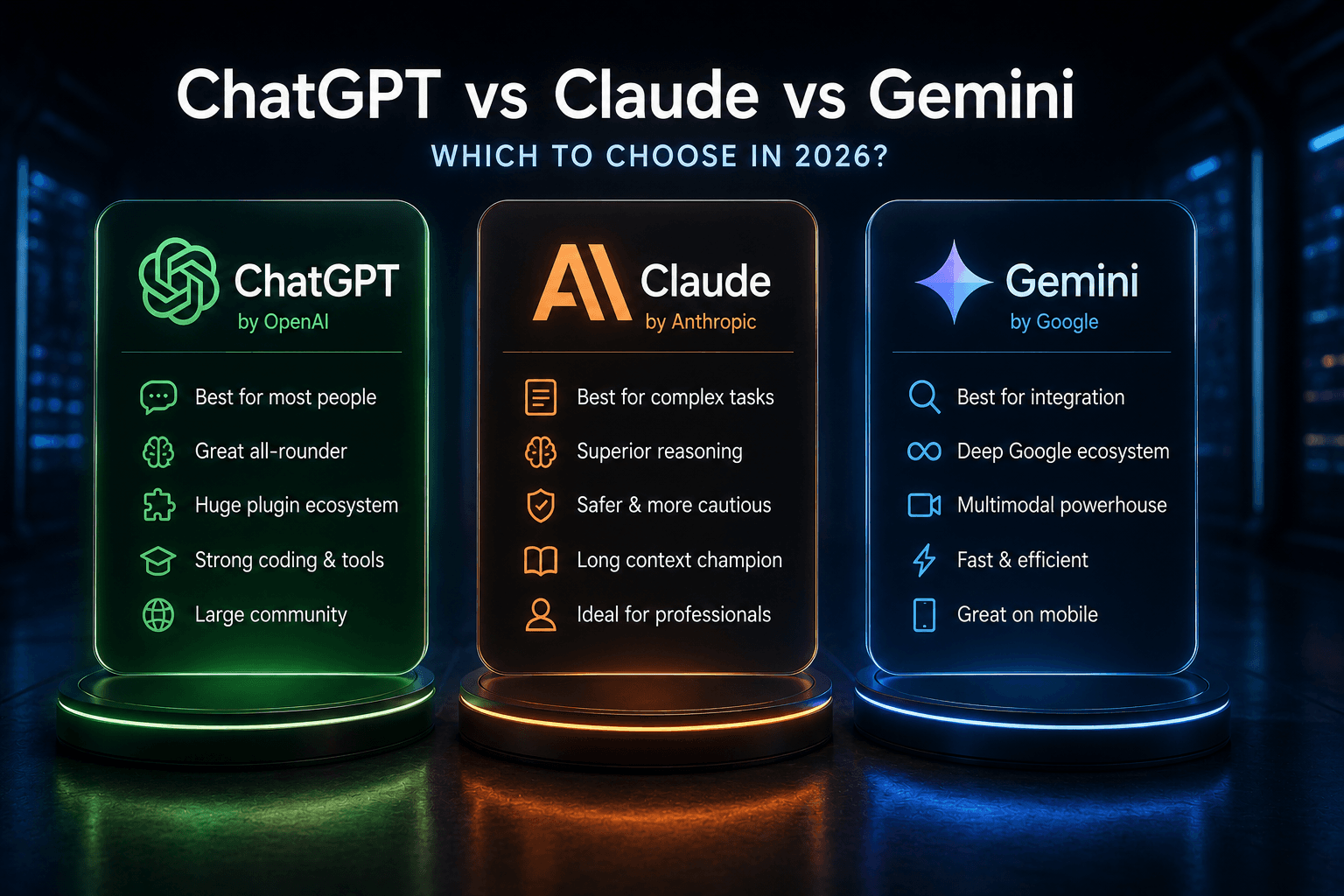
Claude (Anthropic) - the most reliable generalist, spearheaded by Claude Code
Claude's conversational interface now ships with native agentic capabilities: web search, sandboxed code execution, file creation, and connections to third-party tools through MCP (Model Context Protocol), a standard Anthropic has pushed hard as an open industry protocol. But the headline product is Claude Code, Anthropic's terminal-based coding agent, which has reset market expectations for autonomous coding: reading entire codebases, multi-file planning, running shell commands, automated testing, and sessions capable of running unsupervised for tens of minutes at a stretch.
Strengths: reasoning quality and code reliability among the best on the market; context windows reaching 1 million tokens via the API; native integration into existing dev workflows (terminal, VS Code, JetBrains); fast-growing professional adoption, driven partly by strong coding-benchmark results.
Weaknesses: billing built around 5-hour usage windows plus a weekly cap can catch heavy users off guard; the gap between subscription billing and API billing is a recurring source of community confusion; no no-code interface for non-technical users.
Pricing: Claude Pro from roughly $17–20/month (annual/monthly) includes Claude Code with Sonnet as the default model. Claude Max starts at $100/month (5x Pro's limits) and scales to $200/month (20x), with priority access to Opus-tier models. On the team side, Team Standard and Team Premium are billed per seat with a seat minimum. API access is billed per token, at rates that vary by model (Haiku, Sonnet, Opus) - check claude.com/pricing for the current rate card, since Anthropic adjusts these fairly often.
Best for: developers, technical teams, and organizations with high reliability requirements on long-form content or complex code.
Overall score: 9.3/10 - the current benchmark for agentic coding and dependable reasoning, with a pricing structure that takes some getting used to.
ChatGPT Agent and Codex (OpenAI) - the broadest ecosystem, the widest range of uses
OpenAI has built agentic capability directly into ChatGPT: autonomous web browsing, background task execution, code generation via Codex (now included across most ChatGPT tiers), and AgentKit, a developer toolkit for building custom agents on OpenAI's infrastructure. OpenAI's core strength remains breadth: one ChatGPT subscription covers conversation, image generation, deep research, and a coding agent, making it a practical single entry point for anyone who doesn't want to juggle multiple tools.
Strengths: the most complete ecosystem under a single subscription; unmatched consumer adoption, which smooths enterprise rollout; Codex now available starting at entry-level tiers.
Weaknesses: on several independent benchmarks published through mid-2026, the coding agent still trails Claude Code on complex refactoring tasks; the pricing structure (Free, Go, Plus, two Pro tiers, Business, Enterprise) is one of the most fragmented in the market.
Pricing: Free (limited, with ads in the US), Go at $8/month, Plus at $20/month, two Pro tiers at $100 and $200/month (5x and 20x Plus's limits respectively), Business around $20–25/seat/month, Enterprise on request (some sources a $45–75/seat/month range on annual contracts with a seat minimum, but this figure isn't officially published by OpenAI and should be confirmed with their sales team).
Best for: everyday consumers, teams wanting a single all-purpose tool, and organizations already committed to the OpenAI ecosystem.
Overall score: 8.8/10 - the most complete generalist, with a solid but not yet category-leading coding agent.
Cursor - the AI-native code editor developers keep coming back to
Cursor isn't an autonomous agent in the strict sense - it's a code editor, forked from VS Code, with AI woven in at every level: completions, chat, and above all Composer, its agentic multi-file editing mode. Cursor can route requests to several models (Claude, GPT, Gemini) or to its own Composer model, tuned for speed and cost.
Strengths: the smoothest editor-native integration on the market; flexibility to pick your model; Cloud Agents for running long tasks without tying up your local machine; massive adoption (over a million paying subscribers claimed in early 2026).
Weaknesses: the June 2025 shift to credit-based billing triggered real community backlash, with some users seeing higher real-world costs despite an unchanged sticker price; budget predictability is lower than with a fixed-quota subscription.
Pricing: Hobby is free; Pro is $20/month (about $16/month billed annually) with a credit pool matching what you paid; Pro+ is $60/month (3x usage); Ultra is $200/month (20x usage); Business/Teams is $40/seat/month, with a Premium seat at $120/seat/month introduced in June 2026 for heavy agent users.
Best for: individual developers and technical teams who want to stay inside an IDE rather than a terminal.
Overall score: 8.9/10 - one of the best feature-to-experience ratios out there, provided you keep an eye on credit consumption.
Manus - the most spectacular general-purpose agent in demos, now under Meta
Manus made waves in early 2025 with demos showing an agent booking flights, filling out spreadsheets, and browsing the web entirely on its own, inside a virtual-computer environment. After a planned Meta acquisition was initially blocked by Chinese regulators in early 2026, the deal ultimately went through: Manus is now officially part of Meta. Since then, the platform has expanded with a web app builder, Slack, WhatsApp, and Telegram integrations, and a new model family (1.6 Lite, 1.6, 1.6 Max).
Strengths: genuinely strong at complex multi-source web research tasks; a real "virtual computer" environment - actual browser, terminal, and file-system access, not a simulation; a live dashboard that lets you watch the agent work and intervene at any point.
Weaknesses: the credit system, which doesn't roll over month to month, makes budgeting hard for heavy usage; several professional user reports through 2026 flag inconsistent output quality on creative or multilingual tasks, requiring consistent human review.
Pricing: Free with 300 daily credits; Pro from $20/month (roughly 4,000 monthly credits); a second Pro tier at $40/month (roughly 8,000 credits); Extended at $200/month (roughly 40,000 credits) for heavy professional use; Team starting around $20–40/seat/month depending on the source - Team and Enterprise pricing is negotiated directly with Manus and isn't fully published, so confirm before committing.
Best for: content creators, independent researchers, and small teams needing a generalist agent that can handle research and web production end to end.
Overall score: 8.2/10 - impressive on autonomous web research, but the credit system demands careful management.
Devin (Cognition AI) - the autonomous software engineer, premium positioning
Devin launched positioning itself as the first "AI software engineer," able to work inside its own full development environment (IDE, browser, terminal), write code, test it, open pull requests, and fix its own mistakes without constant supervision.
Strengths: real autonomy on multi-hour engineering tasks; capable of handling end-to-end multi-file rewrites; a clear single-purpose focus that avoids the feature sprawl seen in some general-purpose agents.
Weaknesses: pricing well above the rest of the market for individual use; strictly limited to software engineering, with no general-purpose use case; requires full codebase access, which raises governance questions in some organizations.
Pricing: starting around $500/month based on publicly available data - this figure changes regularly, so get a current quote directly from Cognition AI before budgeting.
Best for: engineering teams with a dedicated budget who want to hand off entire development tasks rather than get code suggestions.
Overall score: 8.1/10 - strong on long-horizon autonomy, but an entry price that keeps it for a specific professional audience.
Microsoft Copilot - the most deeply integrated agent in existing office environments
Microsoft Copilot isn't a single product - it's a family of agentic features spread across the entire Microsoft 365 ecosystem: Word, Excel, Outlook, Teams, and Copilot Studio for building custom business agents without code. Since the "Wave 3" update in March 2026, Copilot runs on a multi-model architecture where OpenAI-generated responses can be checked by a second model (Anthropic's Claude) before reaching the user - a feature no other office suite currently matches.
Strengths: unmatched integration into tools businesses already use daily; Copilot Studio lets non-technical teams build business agents; cross-model verification architecture, useful for compliance-sensitive use cases.
Weaknesses: pricing clarity is among the worst in the market, with at least seven distinct products carrying the "Copilot" name, several billing models, and mandatory prerequisite Microsoft 365 licenses whose cost stacks on top of Copilot itself; less relevant for use outside the Microsoft ecosystem.
Pricing: Microsoft 365 Premium with Copilot around $20/month for individuals; Copilot Business as an add-on around $21/seat/month (requires a qualifying Microsoft 365 license); Copilot Enterprise on request, tied to M365 E3/E5 licenses. Exact rates vary by region and change often - Microsoft has announced a global pricing update for July 2026, so confirm current rates before budgeting.
Best for: organizations already heavily invested in Microsoft 365, and non-technical teams wanting to automate office tasks without writing code.
Overall score: 8.0/10 - the best office-suite integration in the market, held back by a confusing pricing structure.
Google Gemini Agent and Antigravity - the high-potential challenger, still finding its footing
Google offers agentic capability through Gemini (search, task execution, Deep Research) and Antigravity, its development environment built for agentic workflows. The launch of Gemini 3.5 Pro, originally slated for June 2026, slipped to July 2026 - worth keeping in mind if you're evaluating Gemini for advanced agentic use cases requiring very long context.
Strengths: Gemini 3.5 Flash, already available, offers a strong speed-to-cost ratio on everyday agentic tasks; the context window announced for Gemini 3.5 Pro (2 million tokens) would, if it holds up, be the largest in the market; distribution built into Search, Android, and Workspace.
Weaknesses: on agentic coding benchmarks published in the first half of 2026, Gemini still trails Claude, and to a lesser extent GPT, on complex tasks; the Pro-tier launch timeline has slipped, which is reason for caution around any announced dates.
Pricing: Free with limited access to Gemini 3.5 Flash; AI Plus and AI Pro at increasing usage tiers (roughly $20/month for the Pro-equivalent tier based on observed consumer pricing); AI Ultra at $200/month for the heaviest usage, at 20x the Pro tier's limits. These prices shift quickly - check the current rate card at gemini.google.com.
Best for: users already inside Google Workspace, and teams wanting to test an extremely large-context tool for document analysis.
Overall score: 7.7/10 - real technical potential, especially on long context, but agentic performance still trailing on complex coding tasks as of this writing.
CrewAI, AutoGen, and LangGraph - frameworks for building your own agents
These three tools aren't ready-made agents - they're open-source frameworks that let developers build custom multi-agent systems. CrewAI organizes teams of agents with defined roles collaborating on a shared task. AutoGen, built by Microsoft Research, structures conversations between agents to solve complex problems iteratively. LangGraph, part of the LangChain ecosystem, models agentic workflows as state graphs, giving fine-grained control over conditional branches and correction loops.
Shared strengths: complete flexibility - you build exactly the agent you need; manageable infrastructure costs since you only pay for the underlying model's API usage; active open-source communities and extensive documentation.
Shared weaknesses: require real development skills, unlike the consumer-facing tools in this ranking; setup time far exceeds that of a ready-made agent; reliability and monitoring rest entirely on the team deploying the agent.
Pricing: all three frameworks are open source and free to use directly. CrewAI also offers a cloud/enterprise tier with observability and managed deployment features, but exact pricing isn't published in a stable way and should be requested directly from the vendor. In every case, real cost mostly comes down to your token usage with whichever model provider you choose (Anthropic, OpenAI, Google, or a self-hosted open-source model).
Best for: technical teams with developers capable of building and maintaining multi-agent systems, and organizations with needs specific enough that no packaged tool covers them.
Overall score: 8.0/10 (for a technical audience) - the highest flexibility on the market, reserved for those who can actually put it to use.
n8n and Flowise - no-code automation with AI agent building blocks
n8n is a workflow automation platform, historically focused on connecting apps together (in the spirit of Zapier or Make), that has added AI agent nodes letting you drop autonomous reasoning into an otherwise standard automation workflow. Flowise follows a similar logic but leans more toward visually building chains and agents based on large language models, using a drag-and-drop interface.
Strengths: accessible to non-developers thanks to the visual interface; n8n can be self-hosted for free, making it the most economical option for anyone with the technical skills to run it themselves; a large library of third-party connectors.
Weaknesses: agentic reasoning depth remains below that of a native agent like Claude Code or Manus on open-ended, complex tasks; the workflow-building learning curve, while gentler than actual software development, is still real for a complete beginner.
Pricing: n8n offers a free self-hosted version (with infrastructure costs on you) and paid cloud plans priced by execution volume that change fairly often - check n8n.io/pricing for current rates. Flowise follows a similar pattern, with a free open-source version and a paid cloud tier whose pricing isn't included here due to a lack of sufficiently recent, reliable sourcing at the time of writing.
Best for: small businesses, freelancers, and marketing or ops teams wanting to automate business processes without hiring a dedicated dev team.
Overall score: 7.8/10 - the best entry point into no-code agentic automation, with clear limits on complex reasoning tasks.
Comparison tables
General comparison
| Agent | Category | Autonomy | Ease of use | Best for |
|---|---|---|---|---|
| Claude / Claude Code | Generalist + coding | Very high | Medium (terminal) | Developers, tech companies |
| ChatGPT Agent / Codex | Generalist | High | High | All-purpose, consumer use |
| Cursor | AI code editor | High | High | Active IDE-based developers |
| Manus | Generalist | Very high | Medium | Web research, creators |
| Devin | Software engineering | Very high | Medium | Engineering teams |
| Microsoft Copilot | Office suite | Medium-high | High | Organizations on M365 |
| Gemini Agent / Antigravity | Generalist | Medium-high | High | Google ecosystem |
| CrewAI / AutoGen / LangGraph | Framework | Configurable | Low (dev required) | Custom technical teams |
| n8n / Flowise | No-code automation | Medium | High (visual) | SMBs, business automation |
Pricing comparison (individual tiers, ascending order)
| Agent | Free entry tier | Entry paid tier | "Power user" tier |
|---|---|---|---|
| n8n (self-hosted) | Yes | Variable (cloud) | Variable |
| Claude | Yes (very limited) | ~$17–20/mo | $100–200/mo |
| ChatGPT | Yes (with US ads) | $8–20/mo | $100–200/mo |
| Cursor | Yes (Hobby) | $20/mo | $60–200/mo |
| Manus | Yes (300 credits/day) | $20/mo | $200/mo |
| Gemini | Yes | ~$20/mo | $200/mo |
| Microsoft Copilot | No (M365 license required) | ~$20–21/mo | On request |
| Devin | No | ~$500/mo | On request |
| CrewAI / AutoGen / LangGraph | Yes (open source) | API usage cost | Enterprise cloud, on request |
Actual autonomy level
| Level | Agents | What it means in practice |
|---|---|---|
| Very high | Claude Code, Manus, Devin | Can run unsupervised for tens of minutes to several hours on a complex task |
| High | ChatGPT Agent, Cursor Agent/Composer | Multi-step with regular checkpoints |
| Medium | Copilot, Gemini Agent, n8n | Strong on defined workflows, weaker on open-ended tasks |
| Configurable | CrewAI, AutoGen, LangGraph | Entirely dependent on how the system is designed |
Best agent by profile
| Profile | Top pick | Alternative |
|---|---|---|
| Solo developer | Claude Code | Cursor |
| Tech startup | Cursor + Claude Code | Devin (budget permitting) |
| Non-technical SMB | Microsoft Copilot or n8n | Manus |
| Creative freelancer | Manus | ChatGPT Agent |
| Marketing team | n8n | Microsoft Copilot |
| Researcher / analyst | Manus | Gemini Agent (long context) |
| Large enterprise | Microsoft Copilot + Claude Enterprise | Custom CrewAI/LangGraph |
Read next
These articles are the best follow-up to what you are reading.
Which AI agent to choose based on your profile
For an individual developer, Claude Code remains the strongest 2026 pick for refactoring, understanding large codebases, and running long unsupervised tasks. Cursor is an excellent complement - or alternative - if you'd rather stay inside a visual IDE than a terminal.
For a tech startup, pairing Cursor for daily work with Claude Code for heavy lifting (migrations, rewrites) gives the best productivity-to-cost ratio. If budget allows and software engineering is the core business, Devin can justify its premium price tag on long-running projects where full autonomy has real value.
For an SMB without a dedicated technical team, Microsoft Copilot is the natural fit if the organization already runs on Microsoft 365 - native integration avoids adding yet another tool to the stack. n8n is a solid alternative for automating specific business processes (invoicing, follow-ups, data syncing) without a prohibitive licensing cost.
For a freelancer, Manus offers the best balance of autonomy and versatility: research, writing, and deliverable creation, with no deep technical skill required. ChatGPT remains a solid alternative if you're already comfortable in its ecosystem.
For a content creator or marketer, n8n handles distribution and monitoring automation, while Manus or ChatGPT Agent covers research and content production.
For a researcher or student, Manus stands out on multi-source web research, while Gemini, thanks to the unusually large context window announced for its upcoming Pro tier, could become a strong fit for analyzing very long documents once it's fully available.
For an entrepreneur juggling several projects, the most effective combination in practice pairs a coding agent (Claude Code or Cursor) for the product, an automation tool (n8n) for recurring processes, and a generalist agent (Manus or ChatGPT) for one-off research and content work.
For an already-structured team, pairing Microsoft Copilot for office use with Claude Enterprise for technical work gives broad coverage, with the option to build custom agents via CrewAI or LangGraph for anything no packaged tool addresses.
Real-world examples
Coding an application: a developer opens Claude Code in their terminal, hands it a spec for an authentication feature, and the agent plans which files to touch, writes the code, runs the existing test suite, fixes the errors it detects on its own, and summarizes the changes before opening the pull request.
Building a website: a freelancer asks Manus to build a landing page for a product launch. The agent generates the structure, writes the copy, picks a coherent visual palette, deploys the result, and hands back a working link within minutes.
Automating a business: an SMB connects n8n to its inbox, CRM, and invoicing tool. Every new quote request triggers a workflow that checks the customer's details, generates a document, and schedules an automatic follow-up if no reply comes within seven days.
Doing research: an analyst asks a deep-research agent to compare the pricing strategies of five competitors. The agent visits each pricing page, pulls the numbers, structures them into a table, and flags inconsistencies or missing data instead of inventing them.
Managing email: an executive sets up Microsoft Copilot to triage their inbox, draft replies to recurring requests, and flag messages that need a human decision.
Organizing a schedule: an agent connected to a calendar spots availability conflicts across several participants, proposes three workable time slots, and sends the invites once a choice is confirmed.
Launching a marketing campaign: a marketer runs an n8n workflow that automatically pulls newly published blog posts, generates social post variants, and schedules them for peak engagement times.
Analyzing data: a Claude- or ChatGPT-style agent receives a quarterly sales file, identifies meaningful trends, generates visualizations, and writes a plain-language summary for a leadership meeting.
Handling repetitive tasks: an accounting firm sets up an agent to automatically extract data from invoices received by email and enter it into their bookkeeping software, with human review reserved for ambiguous cases only.
2026 trends and current limitations
Toward more autonomy, but under tighter supervision
The underlying trend in 2026 is clear: agents are gaining autonomy, but the industry as a whole is converging on stricter supervision mechanisms, not looser ones. "Plan before acting" modes, where the agent presents its strategy before executing it, are becoming standard. Mandatory human checkpoints on sensitive actions - sending an email, making a payment, deploying to production - are becoming the norm rather than the exception.
The regulatory factor is now central
2026 marked a turning point: the availability of a frontier AI model no longer depends purely on business decisions - it increasingly depends on government decisions tied to capability thresholds, particularly around offensive cybersecurity. Several frontier models have had their access restricted or temporarily suspended by US authorities over the course of the year. That dynamic adds a new layer of uncertainty for any organization building a heavy dependency on a single model.
Cost remains a real challenge
Contrary to a common assumption, agents aren't necessarily getting cheaper over time. Agentic tasks consume more tokens than a simple conversation, because every reasoning step, every tool call, every result observation adds to the context. Several vendors revised their usage policies in 2026 to curb runaway consumption, sometimes at the cost of real friction with their user base.
Security and privacy remain frequent blind spots
An agent with access to a browser, a terminal, or an inbox has real power to act - and therefore real risk. Documented cases of agents executing unwanted actions after encountering malicious instructions hidden in a webpage or document remain rare but real, and are a reminder that no agent should be deployed without clear action limits and the ability for a human to intervene immediately.
Hallucinations haven't disappeared - they've shifted
On the conversational side, top models have made real progress on factual reliability. But in an agentic context, a new kind of error has emerged: the agent can hallucinate not a fact, but an action - believing it completed a task correctly when it didn't, or misreading a tool's output. This is currently one of the most active areas of research in the field.
What's likely to change before year-end
Expect consolidation among open-source frameworks around a handful of dominant standards, continued downward pressure on underlying model prices (even as agentic usage costs don't fall at the same pace), and a growing number of certifications and compliance frameworks built specifically for autonomous agents in enterprise settings.
FAQ
Can an AI agent actually replace an employee?
No, not in the overwhelming majority of cases in 2026. Agents excel at well-defined, repetitive tasks, or ones requiring fast execution of multiple steps. They still depend heavily on human oversight for high-stakes decisions, fine-grained contextual judgment, and handling unexpected situations.What's the cheapest AI agent to get started with?
Open-source frameworks (self-hosted n8n, CrewAI, LangGraph) are free to use directly but require technical skills. Among consumer-facing tools, both Manus and Claude offer a limited free tier, with an entry paid tier around $20/month.Are AI agents reliable enough for critical tasks?
Reliability has improved significantly, but no current agent is reliable enough to deploy unsupervised on tasks with irreversible consequences (large financial transactions, medical decisions, legal actions). A human checkpoint is still recommended on any high-stakes action.Should I use a specialized agent or a general-purpose one?
It depends on how recurring your need is. For occasional, varied use, a generalist agent (Manus, ChatGPT Agent) is more than enough. For heavy, repeated use in a specific domain - software development especially - a specialized agent like Claude Code or Devin generally delivers better results.Can I use several AI agents at once?
Yes, and that's actually the most common pattern among advanced users: a coding agent for development, a no-code automation tool for recurring processes, and a generalist agent for one-off research - each covering a different need rather than chasing a single universal tool.Do AI agents pose a security risk to my business?
Risk exists any time an agent has access to sensitive systems without clearly defined action limits. Best practice is to restrict the agent's permissions to what's strictly necessary, enforce checkpoints on irreversible actions, and regularly audit the agent's activity logs.Conclusion: our verdict
There's no single best AI agent in the abstract - only the best agent for your specific situation, and that's probably the single most important takeaway from this comparison. If you're a developer and autonomous coding is your priority, Claude Code stands out today as the most reliable benchmark, with Cursor as an excellent alternative if you'd rather work in a visual environment. If you need a generalist that can handle research, writing, and content production without technical skill, Manus and ChatGPT Agent are neck and neck for the top spot, with a slight edge to Manus on pure web research. If your organization already lives inside Microsoft's ecosystem, Copilot remains the most pragmatic choice despite confusing pricing. And if your needs are too specific for any packaged tool, frameworks like CrewAI and LangGraph offer a freedom nothing else matches, at the cost of real development investment.
One last recommendation that applies across every profile: start small. Test an agent on a low-stakes task before trusting it with anything critical, watch its credit or token consumption from week one, and always keep a human checkpoint on any action that can't be undone. AI agents in 2026 are genuinely impressive - but they're still tools, not a replacement for human judgment.
Neuriflux verdict
Our take: The Best AI Agents in 2026: A Complete Comparison of the Most Powerful AI Agents matters because the real value depends on time saved, code quality, and whether it remains controllable inside a real project.
Detailed Neuriflux score
- Developer productivity : 8.8/10 — the key metric is real time saved.
- Code reliability : 8/10 — high value, but review remains mandatory.
- Workflow fit : 8.5/10 — best when it fits your existing habits.
- Technical risk : Medium — bugs, tech debt, and dependency remain possible.
Who is it actually useful for?
- developers who want speed without losing control
- founders building prototypes fast
- teams looking for a genuinely useful coding assistant
Avoid it if...
- you expect a perfect autonomous developer
- your codebase is sensitive and poorly documented
- you never review generated changes
Why this score?
We do not rate only popularity or marketing promises. The score reflects practical value, maturity, real limitations, potential cost, and long-term relevance for a Neuriflux reader.
> Neuriflux signature — The goal is to separate what is genuinely useful from what is merely well presented. The best choice is not always the most powerful one: it is the one that fits your budget, skill level, and real workflow.
Method and reliability
This article is designed as a living resource. Prices, features, and market positions can change quickly in AI; when a detail depends directly on a vendor, plan, or recent announcement, always check the official page before making a final decision.
Last editorial check: July 2, 2026.
 97% match
 88% match
 91% match
 88% match
 91% match97% match
 84% match
 85% match
 95% match
 88% match
 94% match
 94% match
 88% match
 87% match
 85% match