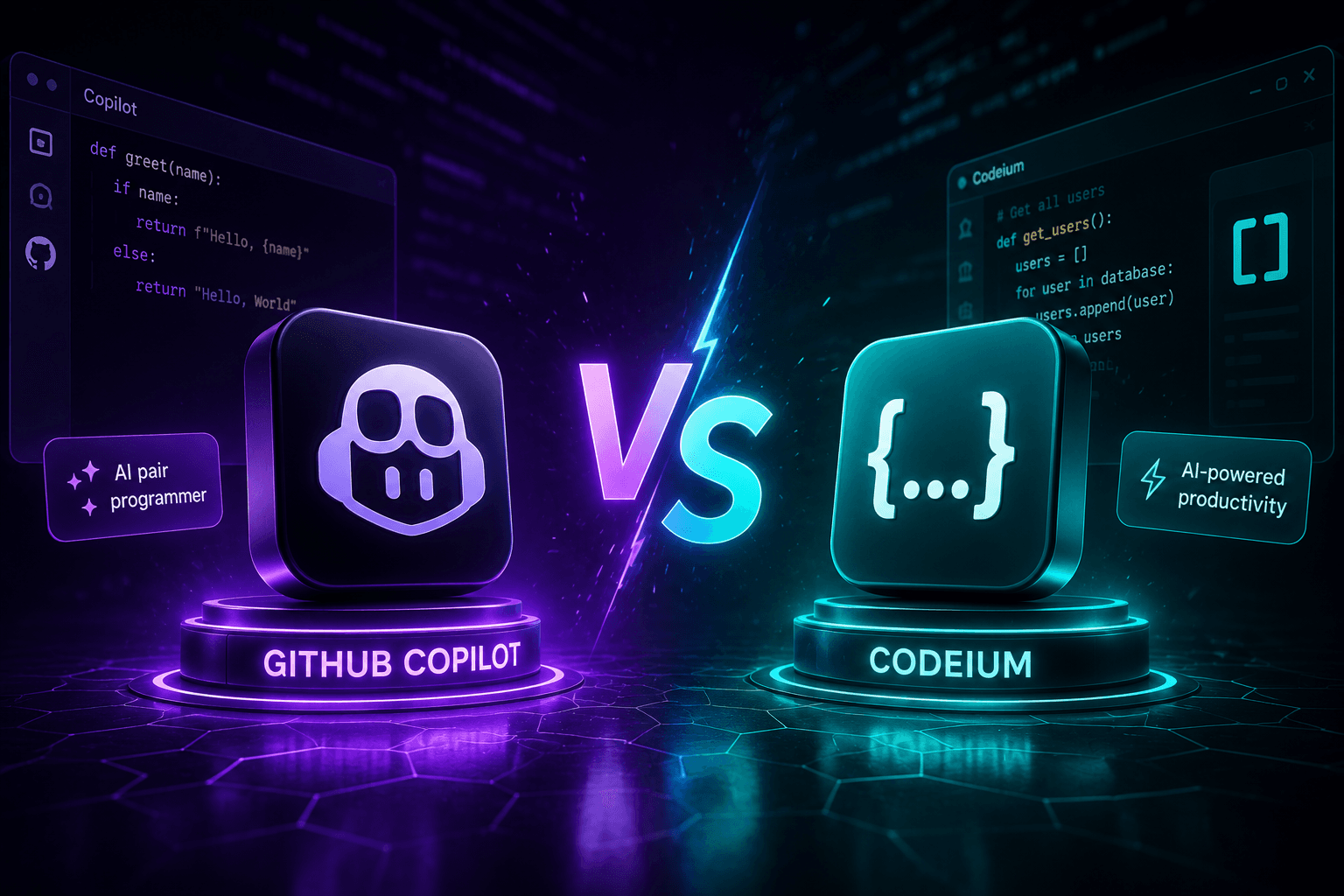
GitHub Copilot vs Codeium: which really boosts your code?
Two assistants, two philosophies. We built 3 complete projects with each to find out.
30-second takeaway
Neuriflux summary: GitHub Copilot vs Codeium: which really boosts your code — the real value depends on time saved, code quality, and whether it remains controllable inside a real project.
- Content type: Code · comparison.
- What you get: a fast read on use cases, limits, alternatives, and decision points.
- Quick verdict: The best choice is not always the most powerful one: it is the one that fits your budget, skill level, and real workflow.
- Editorial score: 8.6/10, adjusted to the topic instead of copied across articles.
Two different philosophies
GitHub Copilot (Microsoft/OpenAI) is the pioneer of AI code assistants. Codeium is the free challenger that wants to democratize AI for developers. We used both for 2 months on Next.js, FastAPI and Python script projects.
GitHub Copilot - The paid reference
Launched in 2021, Copilot has trained millions of developers to work with AI. The 2026 version runs on GPT-4o and Claude 3.5 depending on the task.
Pricing:
| Plan | Price |
|---|---|
| Individual | $10/mo |
| Business | $19/user/mo |
| Enterprise | $39/user/mo |
Weaknesses: paid, and the quality gap with Codeium is narrowing.
Read next
These articles are the best follow-up to what you are reading.
Codeium - The free surprise
Codeium is free for individual developers - and that's its main strength. Suggestion quality is remarkably close to Copilot on most common tasks.
Pricing:
| Plan | Price |
|---|---|
| Individual | Free |
| Teams | $15/user/mo |
| Enterprise | Custom |
Weaknesses: less precise than Copilot on complex suggestions, project context less well managed.
Our verdict
| Criteria | GitHub Copilot | Codeium |
|---|---|---|
| Price | $10/mo | Free |
| Overall quality | ⭐⭐⭐⭐⭐ | ⭐⭐⭐⭐ |
| IDE support | ⭐⭐⭐⭐⭐ | ⭐⭐⭐⭐⭐ |
| AI chat | ⭐⭐⭐⭐⭐ | ⭐⭐⭐⭐ |
| Project context | ⭐⭐⭐⭐ | ⭐⭐⭐ |
Neuriflux verdict
Our take: GitHub Copilot vs Codeium: which really boosts your code matters because the real value depends on time saved, code quality, and whether it remains controllable inside a real project.
Detailed Neuriflux score
- Developer productivity : 8.6/10 — the key metric is real time saved.
- Code reliability : 8/10 — high value, but review remains mandatory.
- Workflow fit : 8.5/10 — best when it fits your existing habits.
- Technical risk : Medium — bugs, tech debt, and dependency remain possible.
Who is it actually useful for?
- developers who want speed without losing control
- founders building prototypes fast
- teams looking for a genuinely useful coding assistant
Avoid it if...
- you expect a perfect autonomous developer
- your codebase is sensitive and poorly documented
- you never review generated changes
Why this score?
We do not rate only popularity or marketing promises. The score reflects practical value, maturity, real limitations, potential cost, and long-term relevance for a Neuriflux reader.
> Neuriflux signature — The goal is to separate what is genuinely useful from what is merely well presented. The best choice is not always the most powerful one: it is the one that fits your budget, skill level, and real workflow.
Method and reliability
This article is designed as a living resource. Prices, features, and market positions can change quickly in AI; when a detail depends directly on a vendor, plan, or recent announcement, always check the official page before making a final decision.
Last editorial check: March 3, 2026.
 97% match
 85% match
 94% match
 93% match
 94% match97% match
 93% match
 84% match
 95% match
 88% match
 91% match
 85% match
 87% match
 88% match
 88% match