OpenAI Raises $122 Billion: $852B Valuation, SuperApp, and IPO on the Horizon
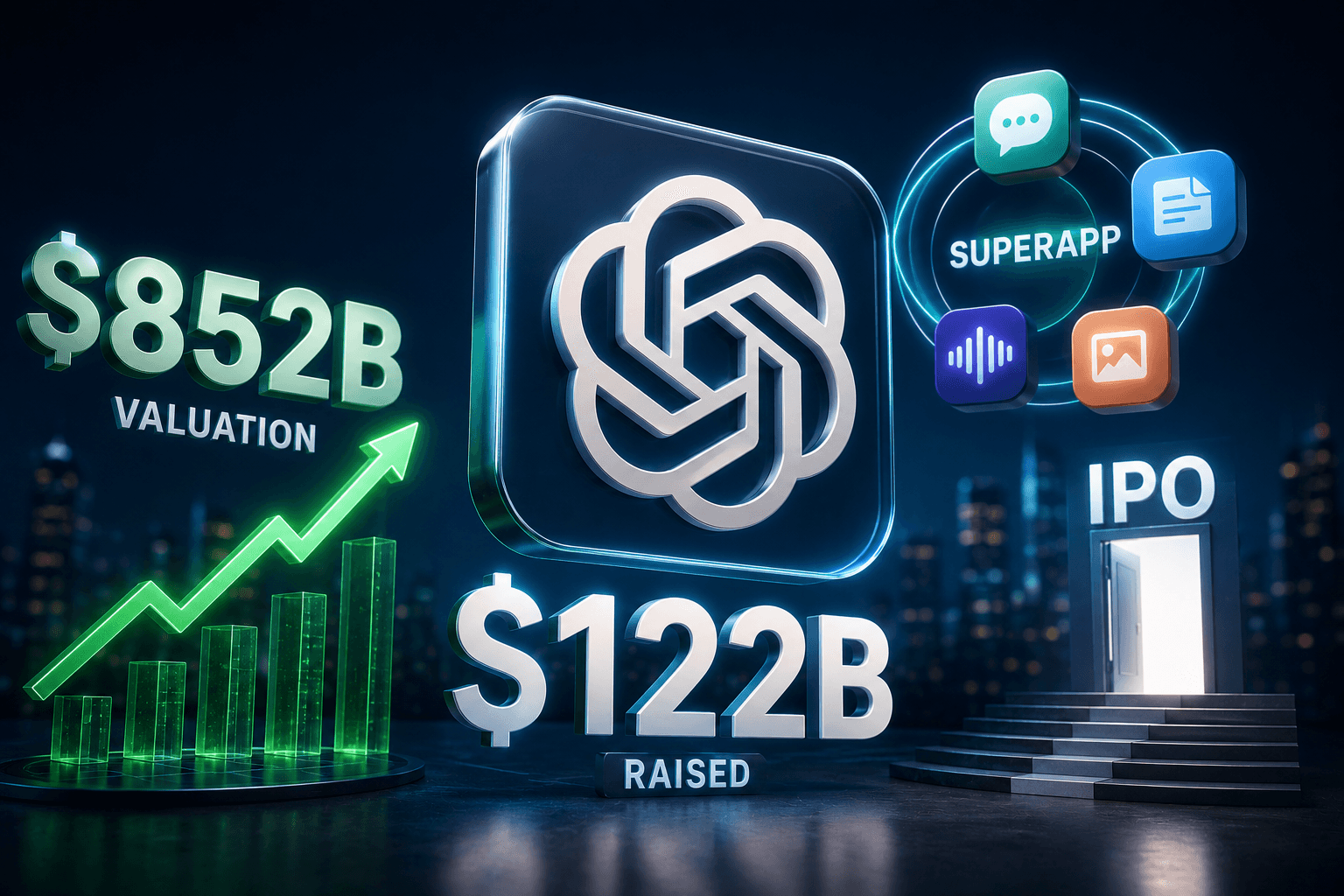
On March 31, 2026, OpenAI closed the largest private funding round in tech history. Amazon, Nvidia, SoftBank - we break down the numbers, the investors, and what this actually changes.
30-second takeaway
Neuriflux summary: OpenAI Raises $122 Billion: $852B Valuation, SuperApp, and IPO on the Horizon — the difference comes down to reliability, memory, reasoning quality, and integration into daily workflows.
- Content type: Chatbots · news.
- What you get: a fast read on use cases, limits, alternatives, and decision points.
- Quick verdict: Worth watching, but with caution: in AI, a big announcement should always be confirmed by real-world use.
- Editorial score: 8.8/10, adjusted to the topic instead of copied across articles.
The biggest private funding round in tech history
On March 31, 2026, OpenAI announced the close of a $122 billion funding round at a post-money valuation of $852 billion. To put that in perspective: it's larger than the market cap of most companies on any major stock index. It surpasses the largest IPO ever completed. According to OpenAI CFO Sarah Friar, the deal "blows out of the water even the largest IPO that's ever been done."
This isn't a standard funding round. It's a market signal of the first order: in 2026, AI has become industrial infrastructure, and OpenAI is positioning itself as its backbone.
The investors and the numbers
The breakdown of participants reveals the strategic - not just financial - logic behind the round.
| Investor | Amount | Relationship type |
|---|---|---|
| Amazon | $50 billion | Cloud + enterprise distribution |
| Nvidia | $30 billion | Chip supplier + infrastructure |
| SoftBank | $30 billion | Co-lead |
| Andreessen Horowitz | Undisclosed | Historical VC |
| Microsoft | Undisclosed | Historical partner ($13B+ already invested) |
| D.E. Shaw Ventures | Undisclosed | Financial institution |
| MGX | Undisclosed | Abu Dhabi sovereign fund |
| TPG | Undisclosed | Private equity |
| T. Rowe Price | Undisclosed | Asset management |
| ARK Invest | Undisclosed | Retail ETFs |
| Sequoia, BlackRock, Fidelity... | Undisclosed | Global institutions |
| Individual investors | $3 billion | Via bank channels (first time ever) |
Amazon puts in $50 billion - $35 billion of which is contingent on OpenAI's IPO or achieving AGI. This is not a simple financial bet: the deal includes a massive cloud partnership, an expansion of the existing $38 billion AWS compute services agreement, and a revenue-sharing arrangement for distributing OpenAI models on Bedrock.
Nvidia commits $30 billion after months of speculation about the final figure. Both companies formalized an agreement for Nvidia to supply 3GW of dedicated inference capacity and 2GW of training on its Vera Rubin systems - a colossal compute commitment.
Individual investors participate for the first time. OpenAI opened the round to private individuals via bank channels, raising more than $3 billion. Inclusion in multiple ARK Invest ETFs will further broaden retail access. The message is clear: OpenAI is building its IPO shareholder base in real time.
The metrics that justify the valuation
An $852 billion valuation for a company that is not yet profitable can seem disconnected from reality. The metrics published alongside the announcement make the investor logic explicit.
$2 billion in monthly revenue. OpenAI generated $13.1 billion in revenue in 2025, and has now reached a monthly run rate of $2 billion. For context: in 2024, the company was at $1 billion per quarter. A year before that, $1 billion for the full year. The growth curve is exponential.
900 million weekly active users. ChatGPT reaches almost a billion people every week. OpenAI claims it was the fastest platform to reach 10 million users, the fastest to 100 million, and will soon be the fastest to one billion weekly.
Over 50 million paying subscribers. ChatGPT search usage has nearly tripled in the past year.
Enterprise is taking over. B2B now represents more than 40% of revenue (up from around 30% last year) and is on track to reach parity with consumer by end of 2026. GPT-5.4 is the engine driving enterprise growth through its agentic capabilities.
APIs process 15 billion tokens per minute. Codex, the autonomous coding tool, surpassed 2 million weekly users - up 5x in three months - with usage growing over 70% month over month.
Advertising hits $100 million annualized in six weeks. OpenAI, which long resisted advertising inside ChatGPT, launched a pilot. The result: $100 million in annualized recurring revenue in under six weeks. A new revenue stream that signals where things are headed.
The SuperApp strategy: the ambition behind the billions
The fundraise is not an end in itself. The blog post OpenAI published on announcement day reveals the strategic ambition driving it: becoming the AI "SuperApp."
"Users do not want disconnected tools. They want a single system that can understand intent, take action, and operate across applications, data, and workflows," OpenAI wrote.
Concretely, this means merging ChatGPT, Codex, web browsing, and agentic capabilities into a single unified platform. A desktop application is in development to centralize everything - what OpenAI refers to internally as its "SuperApp."
The logic is direct: ChatGPT is already part of the daily habits of 900 million people. That consumer familiarity becomes a gateway into enterprise adoption. By unifying product surfaces, OpenAI can ship model improvements directly to users rather than scattering them across fragmented products.
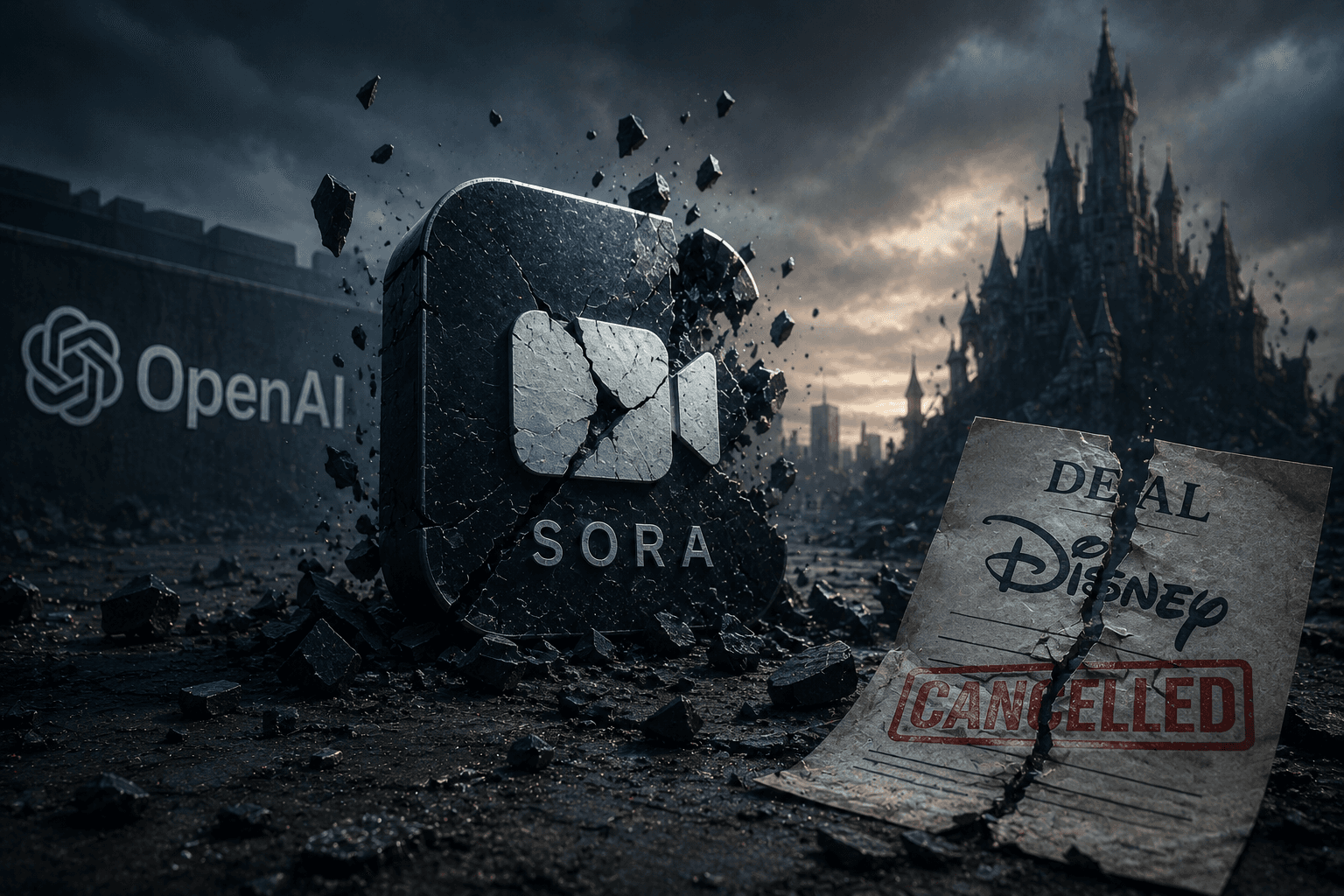
This is also the strategic answer to Sora's shutdown. Rather than maintaining an expensive tool without a solid business model, OpenAI is concentrating resources on an integrated platform where every feature reinforces the others.
The infrastructure: where the money actually goes
$122 billion has to go somewhere. OpenAI was explicit about allocation priorities.
Chips and data centers first. OpenAI has committed to spending more than $1.4 trillion on physical infrastructure over the coming years. This raise directly funds that pipeline. On the chip side, the strategy diversifies beyond Nvidia: AMD, AWS Trainium, Cerebras, and a custom chip project with Broadcom are all in the silicon portfolio.
Five clouds, not one. OpenAI now works with Microsoft, Oracle, AWS, CoreWeave, and Google Cloud. Excessive dependence on a single cloud provider is explicitly avoided - a strategic lesson from previous years.
Credit facility expanded to $4.7 billion. Alongside the raise, OpenAI extended its revolving credit facility to $4.7 billion, backed by several top-tier global banks. A liquidity reserve to absorb spending spikes without additional dilution.
Read next
These articles are the best follow-up to what you are reading.
The IPO backdrop
The real question everyone is asking: when does OpenAI go public?
The official answer remains cautious. CFO Sarah Friar speaks of becoming "public-company capable" as good operational hygiene, without committing to a date. She frames an IPO as a "trust-building moment" for the company.
But the signals are unmistakable. The opening to individual investors via banks. Inclusion in ARK Invest ETFs. The expanded bank credit facility. These are standard pre-IPO preparations. Both leading AI startups - OpenAI and Anthropic - are widely d as 2026 IPO candidates.
The Amazon investment condition is particularly revealing: $35 billion will only be paid when OpenAI either goes public or achieves AGI. Amazon has essentially co-funded a race toward a listing.
What this means for ChatGPT users
What does this raise actually change for someone who uses ChatGPT daily?
More capacity. $122 billion funds data centers and chips. That translates to fewer slowdowns, less queuing, more tokens processed simultaneously. The API already handles 15 billion tokens per minute - that number will keep climbing.
A unified product. The SuperApp in development will replace the current fragmented experience (ChatGPT here, Codex there, browsing elsewhere). A single interface for everything.
Likely more advertising. The ad pilot reaching $100 million annualized in six weeks will almost certainly become a permanent strategy. Free tiers may evolve toward an ad-supported model.
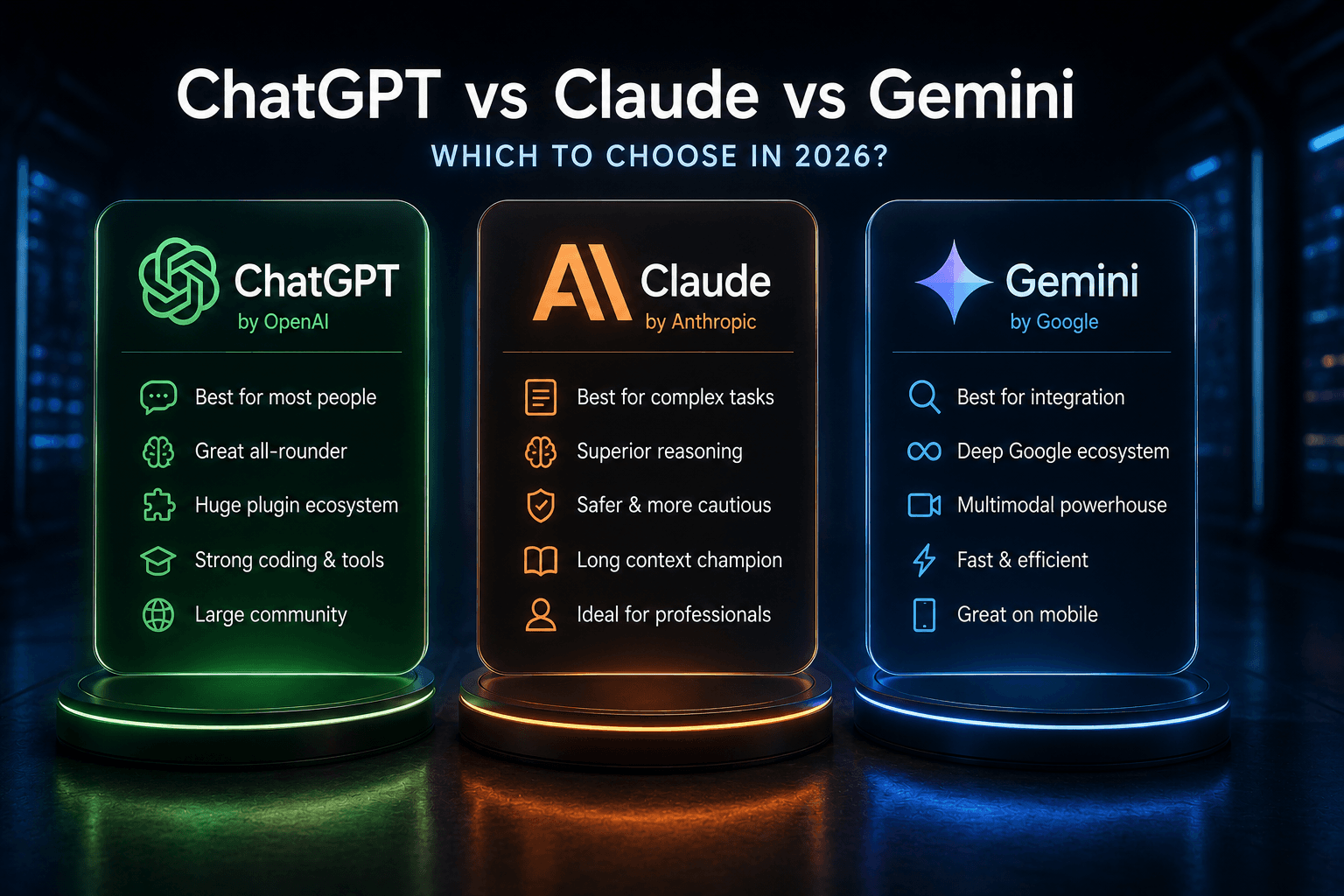
Intensified competition with Anthropic and Google. The more capitalized OpenAI becomes, the greater the pressure on Claude and Gemini - which ultimately benefits users through accelerated innovation.
OpenAI vs Anthropic: the capital race
For context, Anthropic - the company behind Claude - has also raised massive funding, but at a different scale. The company is approaching $19 billion in annualized revenue against OpenAI's $25 billion as of March 2026. OpenAI's $122 billion raise dwarfs Anthropic's rounds, but OpenAI's own CFO acknowledged that both companies have "tapped an overlapping group of investors."
The real competitive dynamic isn't in the capital - it's in the models. Claude Opus 4.6 outperforms GPT-5.4 on several critical benchmarks. The $122 billion gives OpenAI the infrastructure to stay in the race, not a guaranteed win.
Our take on this raise
OpenAI's record fundraise communicates several things simultaneously.
About OpenAI: the growth is real, the monetization works, and the platform is becoming critical infrastructure. $2 billion per month in revenue with 900 million weekly users is traction, not promise.
About the AI industry: capital is concentrating massively in a small number of players. $122 billion for a single unprofitable company is a civilizational bet on the role AI will play in the global economy.
About the IPO: it's a question of when, not if. All signals point to 2026. The test will be whether public markets value a company with exponentially growing revenue that is still burning cash at massive scale.
For users: this raise accelerates innovation but also introduces increased commercial pressure. Advertising in ChatGPT didn't exist a year ago. The SuperApp will concentrate even more data and behavior into a single platform. These are developments worth tracking alongside model performance benchmarks.
FAQ OpenAI fundraising 2026
How much did OpenAI raise in March 2026?
OpenAI closed a $122 billion funding round on March 31, 2026, at a post-money valuation of $852 billion. This is the largest private funding round in tech history, surpassing the previous record of $40 billion raised by OpenAI itself in March 2025.
Who are the main investors in this round?
The three strategic anchors are Amazon ($50 billion), Nvidia ($30 billion), and SoftBank ($30 billion). SoftBank co-led alongside Andreessen Horowitz, D.E. Shaw, MGX, TPG, and T. Rowe Price. Microsoft, Sequoia, BlackRock, Fidelity, and ARK Invest also participated.
Is OpenAI profitable?
No. OpenAI generates $2 billion in monthly revenue ($24 billion annualized) but remains unprofitable due to colossal infrastructure costs - chips, data centers, energy. The company has spent more than $10 billion training and deploying its models since launching commercial products.
When will OpenAI go public?
No date is confirmed, but all signals point to 2026. The opening to individual investors, inclusion in ARK Invest ETFs, and the conditional structure of Amazon's investment ($35 billion contingent on IPO) all point toward an imminent listing.
What is OpenAI's SuperApp?
The SuperApp is the product strategy announced simultaneously with the raise. OpenAI intends to merge ChatGPT, Codex, web browsing, and agentic capabilities into a single unified application. The goal: becoming the primary interface through which users interact with AI - in both personal and professional contexts.
Neuriflux verdict
Our take: OpenAI Raises $122 Billion: $852B Valuation, SuperApp, and IPO on the Horizon matters because the difference comes down to reliability, memory, reasoning quality, and integration into daily workflows.
Detailed Neuriflux score
- Practical value : 8.8/10 — useful for deciding, comparing, or understanding quickly.
- Clarity : 8/10 — accessible without losing important nuance.
- 2026 potential : 8/10 — likely to affect real AI workflows.
- Hype risk : Low to medium — should be validated with concrete tests before adoption.
Who is it actually useful for?
- heavy AI users
- developers and creators
- teams comparing models before paying
Avoid it if...
- you expect one model to be perfect at everything
- you never verify factual answers
- you are highly sensitive to pricing or usage-limit changes
Why this score?
We do not rate only popularity or marketing promises. The score reflects practical value, maturity, real limitations, potential cost, and long-term relevance for a Neuriflux reader.
> Neuriflux signature — The goal is to separate what is genuinely useful from what is merely well presented. Worth watching, but with caution: in AI, a big announcement should always be confirmed by real-world use.
Method and reliability
This article is designed as a living resource. Prices, features, and market positions can change quickly in AI; when a detail depends directly on a vendor, plan, or recent announcement, always check the official page before making a final decision.
Last editorial check: April 1, 2026.
 97% match97% match
 85% match
 97% match
 88% match
 93% match
 84% match
 85% match
 95% match
 83% match
 91% match
 91% match
 85% match
 89% match
 97% match