7 Best Free AI Tools in 2026: Which Ones Are Actually Worth Using?
ChatGPT, Claude, Gemini, Perplexity, Poe… which free AI tools are truly worth your time in 2026? We tested the top options for writing, research, summaries and daily work - plus the real limits nobody mentions.
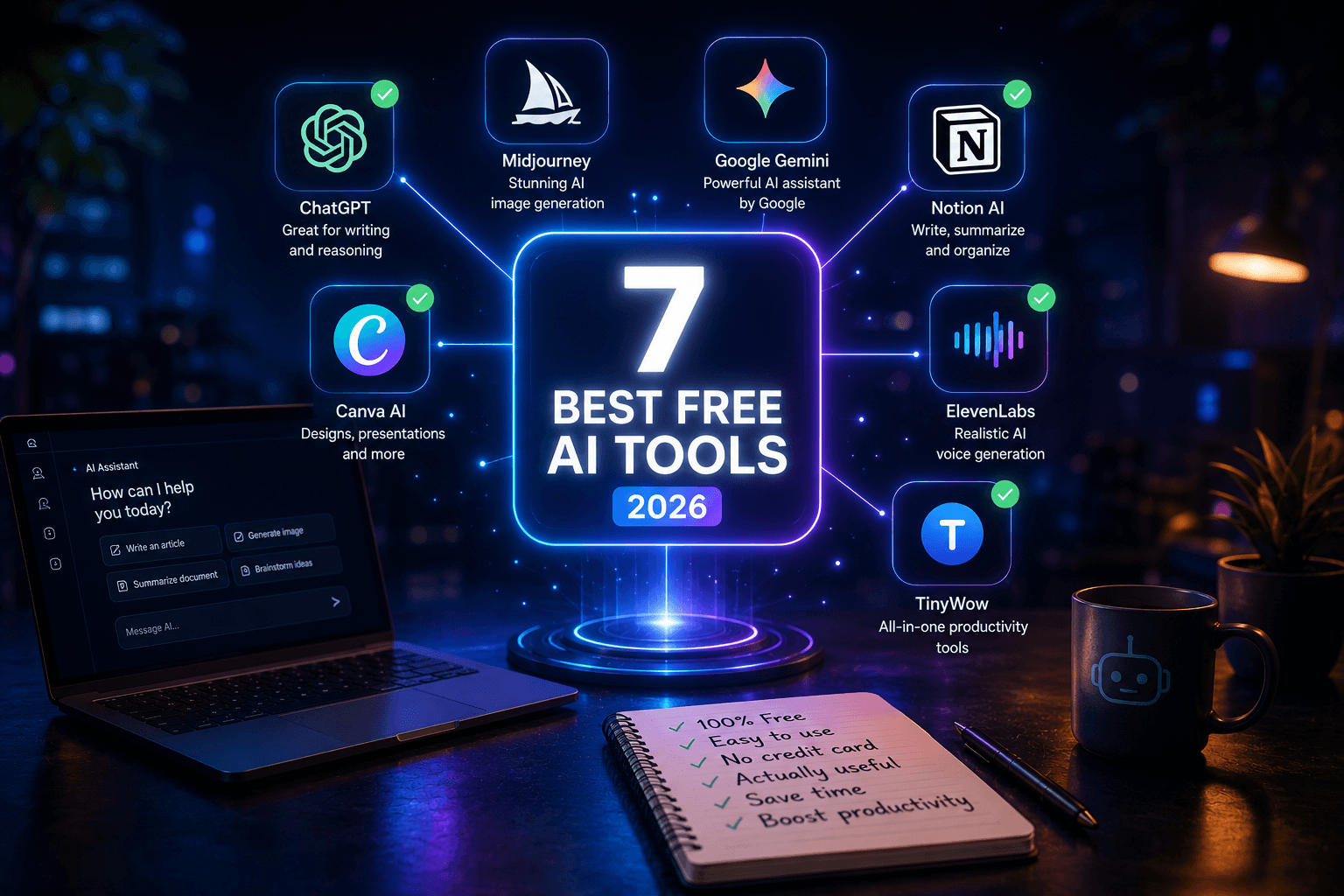
30-second takeaway
Neuriflux summary: 7 Best Free AI Tools in 2026: Which Ones Are Actually Worth Using — the real value depends on time saved, code quality, and whether it remains controllable inside a real project.
- Content type: Chatbots · analysis.
- What you get: a fast read on use cases, limits, alternatives, and decision points.
- Quick verdict: Worth watching, but with caution: in AI, a big announcement should always be confirmed by real-world use.
- Editorial score: 8.8/10, adjusted to the topic instead of copied across articles.
Free AI in 2026: still useful, but no longer truly “free”
By now, almost everyone has typed some version of the same query: best free AI tools.
And it makes sense. AI is no longer niche. People use it to write, summarize, search, learn faster, generate ideas, and save time on everyday work. Naturally, the first instinct is to ask: can I do all of that without paying?
The answer is yes - but not in the simplistic way most roundups pretend.
In 2026, “free AI” usually means one of three things:
- a genuinely usable free tier
- a restricted version with real value, but clear friction
- or a glorified demo designed to make you upgrade as quickly as possible
That’s what this article is about.
We’re not trying to crown a magical universal winner. We’re trying to answer something much more practical: which free AI tools are still genuinely useful today, and what are they actually good for?
What makes a free AI tool worth recommending?
Before naming specific tools, it helps to define the standard.
A good free AI tool should do more than just exist. It should let you complete meaningful work without turning every session into a negotiation with quotas, locked features, or annoying limits.
That means we’re not only looking at raw model quality. We’re also judging:
- whether the free tier feels usable
- whether the limits are reasonable
- whether the tool solves a real problem
- and whether it becomes something you actually return to, rather than something you test once and abandon
1. ChatGPT: still the best all-around free AI for most people
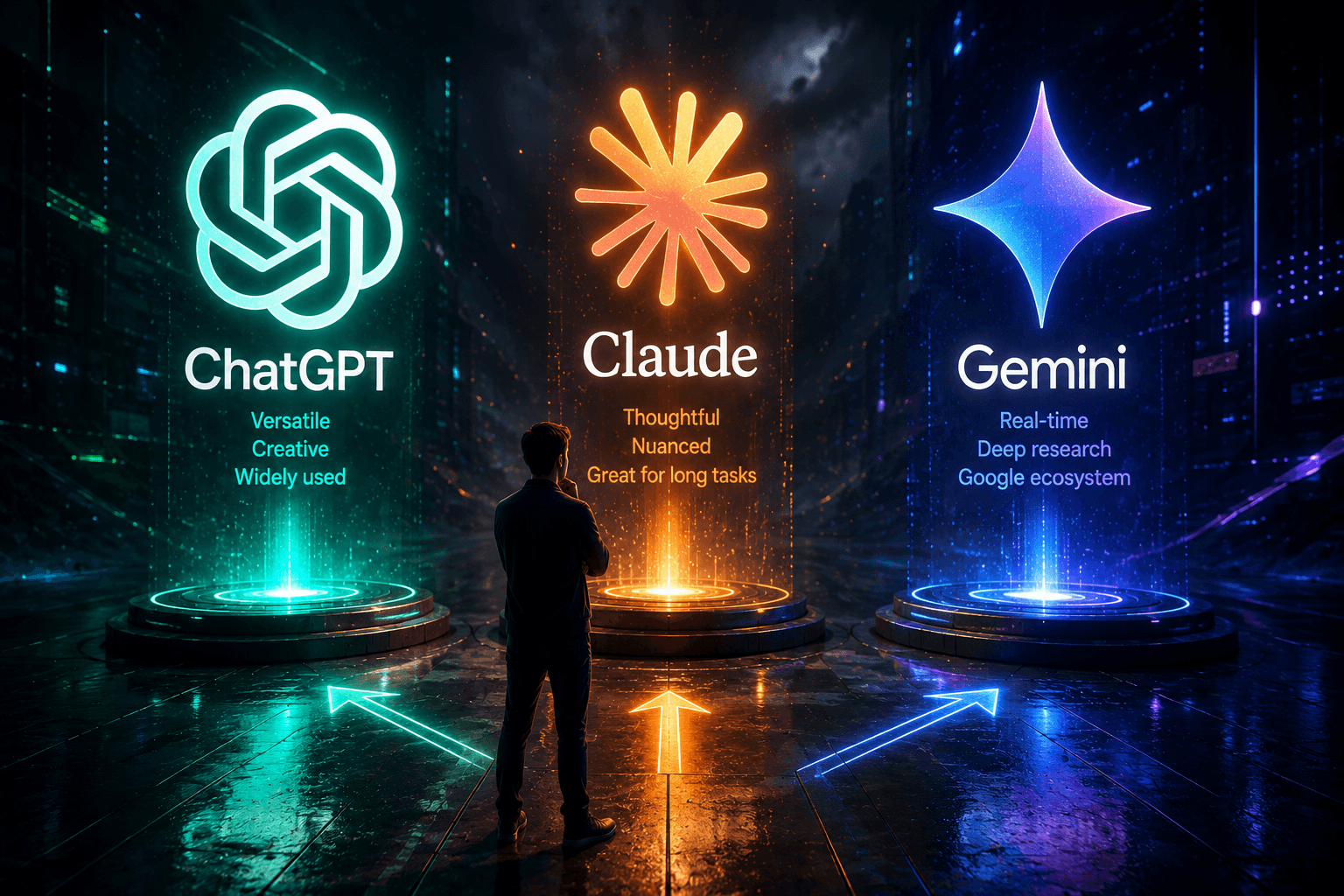
If we had to recommend one free AI tool to the widest number of people, ChatGPT would still be the safest answer.
Not because it dominates every category. It doesn’t. Claude often feels better for writing. Perplexity is often more reliable for research. But ChatGPT remains the most balanced overall package: broad capability, familiar interface, low friction, and enough quality across enough tasks to stay useful every day.
That balance is what matters.
With the free version, you can still do a surprising amount:
- draft text
- rewrite content
- summarize documents
- brainstorm ideas
- ask questions
- structure thoughts
- get basic help with code
- and treat it as a general-purpose assistant for work or personal tasks
The reason ChatGPT stays on top for free users is simple: it’s not just powerful enough, it’s also easy to live with. You don’t need to learn a new system. You don’t need to think about which specialized mode to activate. You open it, ask something, and you usually get something useful fast.
Of course, the limits are real. Heavy usage quickly reveals the boundaries of the free tier. Some advanced features are reserved for paid users. And once AI becomes part of your routine, the upgrade path starts feeling less optional.
But that doesn’t change the core conclusion: for most people, ChatGPT is still the strongest free starting point in 2026.
2. Claude: the free AI that often feels more natural when writing
Claude has become far more than “the other chatbot.”
In some use cases, it’s simply the better experience. That is especially true for writing-heavy tasks, thoughtful analysis, and long-form outputs where tone and flow matter.
What makes Claude stand out is not just intelligence, but texture. Its responses often feel more measured, more human, and less mechanically structured than many alternatives. If your main use case is writing, editing, outlining, or thinking through an idea in a more nuanced way, Claude can feel remarkably strong.
That’s why so many people now use it as their “second brain” for:
- article drafting
- rewriting
- text polishing
- long summaries
- thoughtful planning
- and deeper explanation work
Still, there’s a reason Claude isn’t the universal number-one recommendation for free users: its free access can feel less stable over time. Depending on volume and timing, usage caps can arrive faster than you’d like. That doesn’t make it bad. It just makes it harder to rely on as your only tool.
So while ChatGPT remains the best one-tool recommendation, Claude is arguably the better writing companion when it’s available.
And that’s the key distinction: Claude is not always the best free AI overall, but it is often the one that feels best when the task is language itself.
3. Perplexity AI: the best free AI for research and fact-finding
Perplexity is valuable for a different reason.
It’s not trying to be your universal chatbot. It’s trying to compress the internet into a faster, more usable research workflow. And in that role, it’s one of the best free AI tools available today.
Its biggest advantage is obvious but powerful: it ties answers to sources.
That changes the relationship you have with the tool. Instead of receiving a polished paragraph and wondering whether it invented half of it, you get a synthesis anchored in real pages. That doesn’t mean it’s magically infallible. But it dramatically improves trust and speed when you’re gathering information.
Perplexity is excellent for:
- quick research
- trend checks
- first-pass summaries
- validating claims
- finding source material
- and reducing the number of tabs you need open
Where it’s weaker is creativity. If your goal is deep rewriting, ideation, or original long-form writing, Perplexity is not always the most enjoyable tool. But that’s fine. It isn’t meant to win there.
What it does win is time saved on information retrieval. And for many users, that is the most immediate and measurable AI benefit of all.
4. Gemini: useful enough, but rarely the most compelling choice
Gemini benefits from scale, visibility, and Google’s ecosystem.
That alone makes it impossible to ignore. For many users, it’s the easiest AI to try because it sits close to products they already use. And for light everyday tasks, that convenience genuinely matters.
The problem is not that Gemini is bad. The problem is that it often feels merely adequate when competitors feel sharper.
It can answer quickly. It can help on simple prompts. It can assist with basic writing or everyday queries. But compared with ChatGPT’s versatility, Claude’s writing quality, or Perplexity’s research strength, Gemini often lands in the “fine, but not exciting” zone.
That doesn’t mean it has no place. It’s still worth having in the mix, especially if you’re already deep in Google’s environment and want a straightforward assistant without extra setup.
But if someone asks: is Gemini the best free AI in 2026? The honest answer is probably no.
If they ask: is Gemini still worth using? Yes - just with more modest expectations.
5. Poe: great for exploring multiple models, less great for settling into one workflow
Poe’s value proposition is easy to understand: access multiple AI models from one place.
That’s a smart idea. Instead of signing up for several platforms, you get a kind of AI control panel where you can sample different styles and capabilities more quickly. For people who like experimenting, that is genuinely convenient.
This makes Poe one of the best tools for comparison and discovery.
But discovery and daily usage are not the same thing.
The free experience on Poe tends to feel more constrained once you try to rely on it for real work. Limits become part of the workflow. You stop thinking about the result and start thinking about credits. That shift matters more than people realize, because it changes the emotional feel of the tool.
So Poe is absolutely worth mentioning, but for a specific reason: it helps you explore the AI landscape. It’s less convincing as the platform you settle into for heavy ongoing work.
If you want to understand what different models feel like, Poe is strong. If you want one stable free AI companion, there are usually better options.
Read next
These articles are the best follow-up to what you are reading.
6. Hugging Face: the richest free AI playground, but not built for everyone
Hugging Face earns its place for a very different reason.
This is not the polished, low-friction recommendation you’d give to someone who just wants help writing emails. It’s more like the open landscape behind the polished consumer apps. A place where you can discover models, demos, experiments, niche tools, and open-source alternatives that rarely appear in mainstream rankings.
That makes it incredibly valuable - but not universally approachable.
Hugging Face can be messy. Quality varies widely. Interfaces are inconsistent. Some tools feel brilliant, others feel half-finished. The learning curve is higher, and the experience is clearly more technical.
But if you are curious, willing to test, or interested in AI beyond the usual five big products, Hugging Face can offer more freedom than almost any commercial free tier.
So no, it’s not the best free AI for the average person. But it may be the most interesting free AI ecosystem for people who want more than a clean chatbot box.
7. You.com: promising, usable, but still not an obvious first choice
You.com is one of those tools that feels like it could become much more important than it is today.
The product idea is strong. There’s a useful mix of search, assistance, and productivity-oriented interaction. In some situations, it feels close to becoming a real alternative to bigger names. But consistency is still the issue.
At its best, it’s helpful and efficient. At its worst, it feels like a product that hasn’t fully solidified its identity.
That means it’s worth watching, worth trying, and sometimes worth using - but not yet something we’d rank above the more established options.
So while it deserves a place in this list, it deserves it as a promising free option, not as an essential one.
Which free AI should you actually choose?
This is where rankings become more useful when they turn practical.
If you want one tool that can do a bit of everything, ChatGPT is still the safest free pick.
If your priority is writing quality, tone, and long-form coherence, Claude often feels better.
If your priority is research, fast answers with sources, and reducing time spent searching, Perplexity is the strongest choice.
If your priority is exploration and comparing models, Poe makes sense.
If your priority is open experimentation and discovering what exists outside commercial consumer apps, Hugging Face is the richest option.
And if you just want another accessible assistant in the Google world, Gemini remains relevant even if it isn’t the most exciting.
That’s why the real winning strategy in 2026 is not blindly chasing “the best free AI.” It’s building a simple stack of two or three tools that each do one thing well.
For most users, that stack is:
- ChatGPT for general use
- Claude for writing
- Perplexity for research
The real limits of free AI in 2026
It’s also worth saying this clearly: free AI is not free because companies are feeling generous.
Inference is expensive. Every serious model costs money to run. So free tiers are structured with intent. They’re there to prove usefulness, create habit, and eventually make the paid tier feel justified.
That usually means:
- usage caps
- softer throttling
- hidden friction
- premium features locked away
- and an experience that works well enough to hook you, but not always well enough to fully replace a subscription
The mistake is expecting a free tier to behave like a full unlimited product.
The smarter approach is to accept that limits exist, then choose the tools whose limits are still compatible with your workflow.
And that is exactly why these seven tools matter: they remain useful despite the constraints.
Our final verdict
If we strip away the marketing and keep only what matters, the conclusion is simple:
Yes, free AI is still worth using in 2026. But the best results come from using the right tool for the right job.
ChatGPT remains the best overall free recommendation because it balances breadth, ease of use, and quality better than anything else.
Claude is the free tool that most often feels superior when writing matters.
Perplexity is the free tool that saves the most time when information quality matters.
Everything else depends on your profile, your patience, and how far you want to go.
So no, you do not need to pay immediately to benefit from AI in 2026. But you do need to stop thinking in terms of a single miracle tool and start thinking in terms of fit.
That’s the real difference between casually trying AI and actually getting value from it.
FAQ Free AI Tools 2026
What is the best free AI tool in 2026?
For most people, ChatGPT remains the best overall free AI tool in 2026 because it combines versatility, ease of use, and broad capability. Claude is often better for writing, while Perplexity is often better for research.
Can free AI tools be enough for work?
Yes, in many cases. Free AI tools are already strong enough for drafting, summarizing, brainstorming, researching, and everyday assistance. But if you rely on AI heavily every day, usage caps and locked features eventually become more noticeable.
Why do all free AI tools have limits?
Because running modern AI models is expensive. Free tiers are designed to showcase value while keeping costs manageable and encouraging upgrades for power users.
Which free AI tool is best for reliable information?
Perplexity is one of the strongest free choices for research because it links answers to sources. For fact-heavy tasks, it is often a better starting point than a standard chatbot on its own.
Should I use one free AI tool or several?
Several is usually smarter. ChatGPT for general tasks, Claude for writing, and Perplexity for research is one of the best free setups available in 2026.
Neuriflux verdict
Our take: 7 Best Free AI Tools in 2026: Which Ones Are Actually Worth Using matters because the real value depends on time saved, code quality, and whether it remains controllable inside a real project.
Detailed Neuriflux score
- Developer productivity : 8.8/10 — the key metric is real time saved.
- Code reliability : 8/10 — high value, but review remains mandatory.
- Workflow fit : 8.5/10 — best when it fits your existing habits.
- Technical risk : Medium — bugs, tech debt, and dependency remain possible.
Who is it actually useful for?
- developers who want speed without losing control
- founders building prototypes fast
- teams looking for a genuinely useful coding assistant
Avoid it if...
- you expect a perfect autonomous developer
- your codebase is sensitive and poorly documented
- you never review generated changes
Why this score?
We do not rate only popularity or marketing promises. The score reflects practical value, maturity, real limitations, potential cost, and long-term relevance for a Neuriflux reader.
> Neuriflux signature — The goal is to separate what is genuinely useful from what is merely well presented. Worth watching, but with caution: in AI, a big announcement should always be confirmed by real-world use.
Method and reliability
This article is designed as a living resource. Prices, features, and market positions can change quickly in AI; when a detail depends directly on a vendor, plan, or recent announcement, always check the official page before making a final decision.
Last editorial check: April 11, 2026.
 97% match97% match
 85% match
 97% match
 93% match
 93% match
 85% match
 84% match
 95% match
 88% match
 91% match
 85% match
 86% match
 89% match
 97% match