Is ChatGPT Losing to Claude and Gemini? What the Numbers Actually Say in 2026
ChatGPT is still the biggest AI chatbot in 2026. But Claude is winning over demanding users, while Gemini is spreading through Google’s distribution power. Here’s the full analysis of the shift.
30-second takeaway
Neuriflux summary: Is ChatGPT Losing to Claude and Gemini? What the Numbers Actually Say in 2026 — the difference comes down to reliability, memory, reasoning quality, and integration into daily workflows.
- Content type: Chatbots · analysis.
- What you get: a fast read on use cases, limits, alternatives, and decision points.
- Quick verdict: Worth watching, but with caution: in AI, a big announcement should always be confirmed by real-world use.
- Editorial score: 8.8/10, adjusted to the topic instead of copied across articles.
The question changed in 2026
For most of the last two years, the AI chatbot market was easy to explain. ChatGPT was not just the largest product in the category - it was the category. For mainstream users, trying AI often meant opening ChatGPT, and for competing startups, launching a new model usually meant being compared to OpenAI within minutes.
That is still partly true in March 2026. But only partly.
The important change is not that ChatGPT has collapsed. It clearly has not. OpenAI still says ChatGPT has more than 800 million weekly active users, and that kind of scale is hard to overstate. Very few consumer software products ever reach that level of habitual use. ChatGPT remains the most visible AI brand in the world, and for millions of users it is still the default starting point.
What changed is something more strategic: ChatGPT is no longer the only credible answer to the question of which AI assistant matters most.
Claude has started to win in the part of the market where trust, output quality, and technical reputation carry disproportionate weight. Gemini, meanwhile, is becoming powerful in a very different way: not by outperforming ChatGPT in public conversation, but by embedding itself inside the digital infrastructure people already live in.
That is why the market feels different now. The debate is no longer “Who has heard of ChatGPT?” The debate is “Who owns the next layer of habitual AI use?”
ChatGPT still leads in scale, but scale is no longer the whole story
The strongest argument in OpenAI’s favor remains obvious: size.
ChatGPT still has the broadest adoption footprint that we can publicly verify. More than 800 million weekly active users is not just a healthy metric - it is a sign of category leadership at a global level. That number alone explains why so many competitors continue to define themselves against ChatGPT rather than the other way around.
But markets do not move on scale alone. They move on momentum, positioning, and where users go when their needs become more specific.
That is why Google’s number matters so much. Gemini passed 750 million monthly active users by the end of 2025, according to Google. Monthly users and weekly users are not identical metrics, so the comparison should not be abused. But the strategic implication is clear enough: Gemini is already operating at a level where it cannot be dismissed as secondary.
Claude’s case is different. Anthropic has not published a consumer base number with that level of visibility, which makes direct scale comparisons difficult. Yet Claude’s recent signals point in one direction: acceleration. Early March data relayed by TechCrunch showed Claude reaching 149,000 daily downloads in the U.S., compared with 124,000 for ChatGPT, based on Appfigures estimates. Around the same period, Claude briefly overtook ChatGPT in the U.S. App Store rankings. That does not mean Claude suddenly became the dominant chatbot in America. But it does mean something symbolically important happened: the category leader looked vulnerable in public.
Then there is the stronger signal underneath the headlines. Anthropic said Claude’s paid subscriptions have more than doubled this year. That matters because downloads can reflect curiosity, while paid subscriptions reflect conviction. Users are not just checking Claude out. A growing share of them appear willing to commit budget to it.
In practical terms, the market now looks less like a monarchy and more like a hierarchy under pressure.
Why Claude’s rise matters more than its raw size
Claude is not trying to be everything to everyone, and that has become one of its biggest advantages.
Anthropic has spent the past year building a product identity that feels unusually coherent for the AI space. Claude is widely seen as calm, structured, reliable, and strong on long-form reasoning and coding-oriented work. Whether every one of those perceptions is always true in every workflow is almost secondary; in markets like this, perception itself becomes a strategic asset.
That reputation gives Claude a special kind of leverage. It does not need to outgrow ChatGPT across the whole population to become dangerous. It only needs to become the preferred tool among the users who influence everybody else: developers, product teams, technical leads, writers, founders, analysts, and serious power users.
Those people often decide what a team uses, what a startup integrates, what a creator recommends, and what an organization pays for. So when Claude improves its standing among them, its impact can travel much further than its raw user count suggests.
This is also why Claude’s momentum feels different from a typical viral spike. It is not just “more attention.” It is attention concentrated in the most opinion-shaping layer of the market.
That kind of growth tends to be stickier than headline hype.
Gemini is playing a much bigger game than most people realize
If Claude challenges ChatGPT through preference, Gemini challenges it through environment.
Google’s strategic position is radically different from OpenAI’s or Anthropic’s. OpenAI needs people to keep choosing ChatGPT as a destination. Anthropic needs people to discover Claude, like it, and stick with it. Google, by contrast, can make AI usage happen upstream. It can place Gemini inside Search, Gmail, Docs, Android, Drive, Chrome, and the broader set of interfaces through which people already manage work and life.
That distinction is enormous.
A standalone chatbot asks for intent: open the app, type the prompt, engage with the tool. An embedded assistant removes that friction. The AI is simply there when the user reaches for an existing product. Over time, that can be even more powerful than being perceived as the “best chatbot,” because it shifts behavior without requiring a strong conscious decision.
This is why Gemini is easy to underestimate if you only look at public exment. Its strategic advantage is not necessarily product love. It is distribution gravity.
And distribution gravity matters even more in mature software markets than in young ones. As AI becomes less of a novelty and more of a routine layer, the winning products may be the ones that reduce choice rather than demand it. Gemini fits that model extremely well.
In that sense, Google is not just competing in chat. It is competing for the default surface through which people will use AI at all.
Read next
These articles are the best follow-up to what you are reading.
Why ChatGPT feels less untouchable now
The most important shift is psychological, not numerical.
In 2023 and 2024, ChatGPT was both the largest tool and the most obvious recommendation. That combination made it feel nearly unassailable. Today, it remains the largest, but it is no longer the obvious answer for every serious use case.
Part of that comes from its own success. ChatGPT has become broader and more ambitious. It is a consumer assistant, a conversational search product, a coding interface, a voice product, a business tool, and increasingly a monetized media surface. OpenAI’s U.S. ad pilot even surpassed $100 million in annualized revenue within six weeks, which shows just how commercially powerful that scale can be. But breadth has a cost: the product can start to feel less sharp, less singular, and less clearly “the best” at any one thing. :contentReference[oai:2]{index=2}
At the same time, the market has matured. Users are no longer asking only which AI chatbot is most famous. They are asking which one writes best, which one codes best, which one fits inside their company stack, which one they trust with longer workflows, and which one feels most natural inside the tools they already use.
That kind of market punishes complacency. It does not necessarily remove the leader. But it slowly chips away at the leader’s sense of inevitability.
And that may be the most important sentence in this entire analysis: ChatGPT is still ahead, but it no longer feels inevitable.
What this tells us about the AI chatbot market in 2026
The category is not moving toward a single all-powerful winner. It is moving toward segmentation.
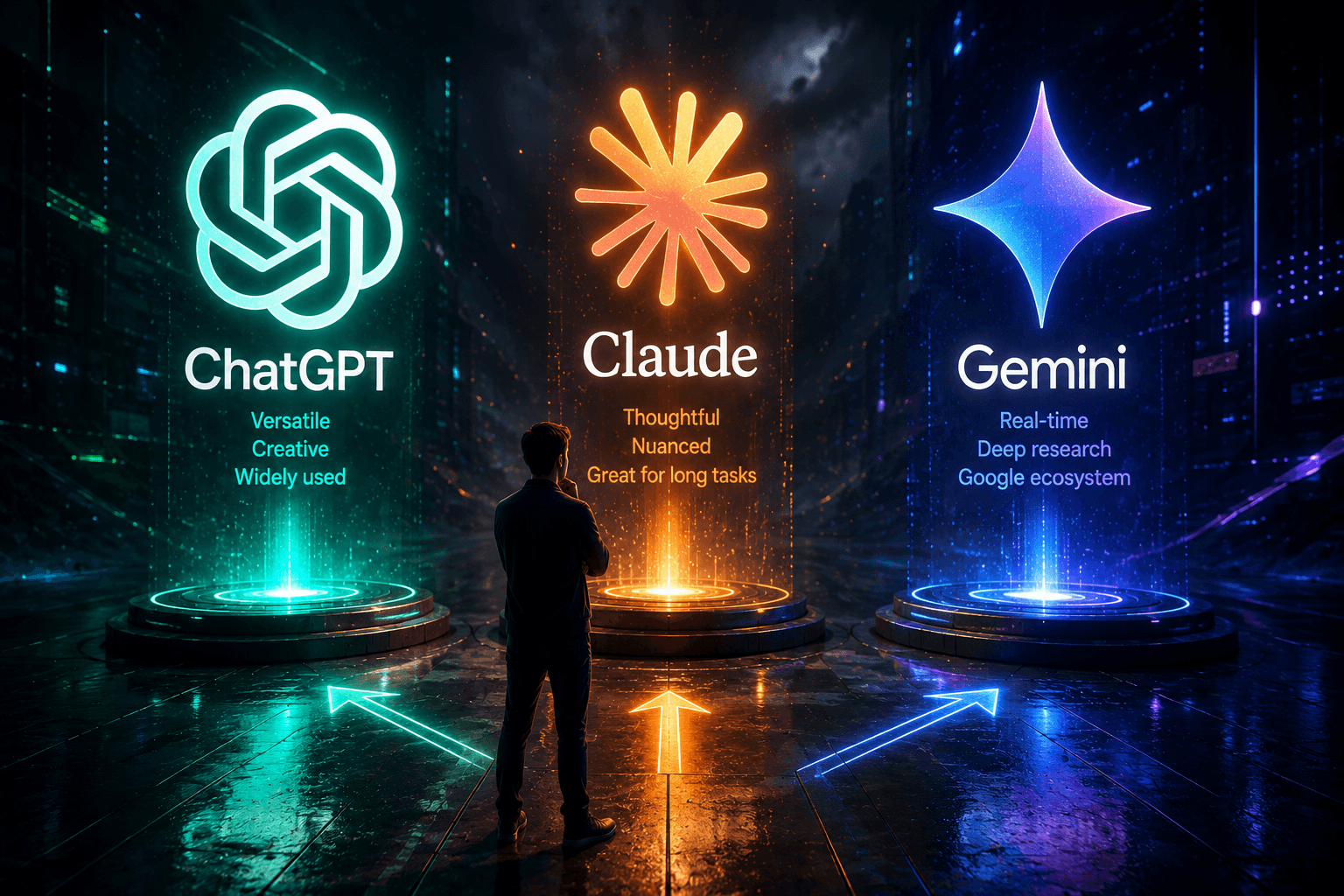
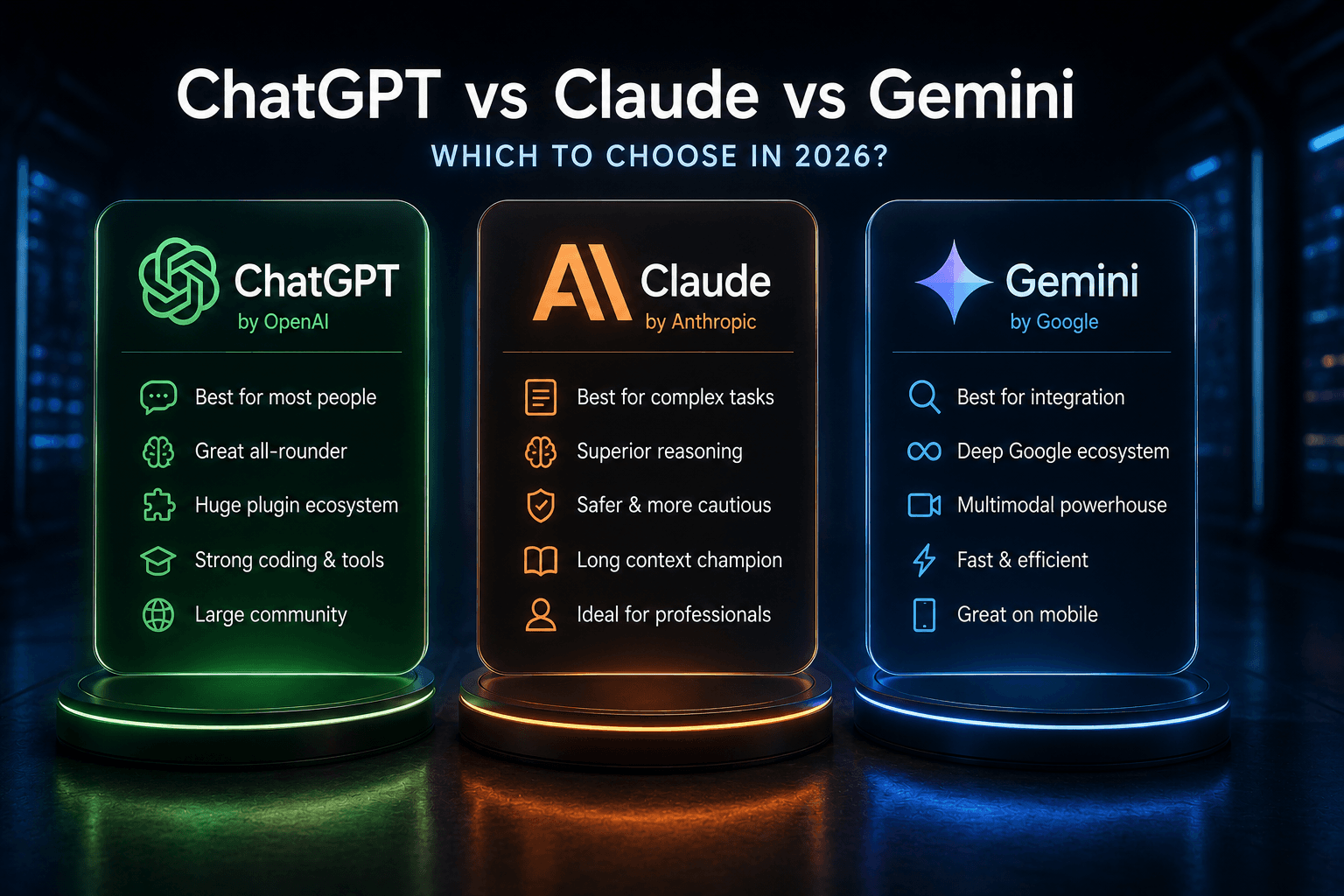
ChatGPT remains the broad consumer leader, the product most people know, the one most users can start with, and the easiest general recommendation. Claude is becoming the preferred answer in a more professional or demanding context, especially where clarity, depth, and long-form work matter. Gemini is becoming the strongest option where AI is not treated as a destination product, but as an integrated capability across an ecosystem.
That is a more mature market structure. It also means future leadership will not be decided by one number alone.
The winners will be determined by who owns default behavior in different contexts: mainstream prompts, enterprise workflows, creator stacks, technical tasks, search surfaces, inboxes, operating systems, and collaboration suites.
ChatGPT still owns a huge portion of that map. But for the first time, it has to defend multiple fronts at once.
Our verdict: ChatGPT is still first, but no longer unquestioned
The lazy conclusion would be that Claude is “beating” ChatGPT. The opposite lazy conclusion would be that ChatGPT remains so large that nothing else matters.
Both are wrong.
ChatGPT still leads the market by scale, visibility, and mainstream recognition. That part remains true. But Claude is increasingly capturing the users whose opinions and budgets matter most for premium adoption, and Gemini is building a structural position through Google’s distribution machine that could become even more powerful over time.
So the right conclusion is not that ChatGPT is losing the market today.
It is that ChatGPT has started losing something almost as important: the unquestioned mental monopoly it once had over the category.
And in technology markets, that is often where the real competitive era begins.
FAQ
Is ChatGPT still the biggest AI chatbot in 2026?
Yes. OpenAI says ChatGPT has more than 800 million weekly active users, which still makes it the largest consumer AI chatbot brand by publicly available scale.
Did Claude really overtake ChatGPT?
Not globally. But Claude briefly overtook ChatGPT in the U.S. App Store in early March 2026 and showed stronger short-term momentum in U.S. mobile downloads and paid subscriptions.
Is Gemini a serious threat to OpenAI?
Yes, especially over the long term. Gemini benefits from Google’s massive distribution advantage across Search, Android, Gmail, Docs, and the wider Google ecosystem.
Which AI chatbot is best in 2026?
There is no single universal answer anymore. ChatGPT remains the most versatile mainstream choice, Claude is increasingly preferred by advanced users and developers, and Gemini is becoming stronger for users already embedded in Google’s tools.
Is ChatGPT losing the market?
Not in raw scale. What it is losing is the sense that it is the only obvious choice. That alone is a meaningful competitive shift.
Neuriflux verdict
Our take: Is ChatGPT Losing to Claude and Gemini? What the Numbers Actually Say in 2026 matters because the difference comes down to reliability, memory, reasoning quality, and integration into daily workflows.
Detailed Neuriflux score
- Practical value : 8.8/10 — useful for deciding, comparing, or understanding quickly.
- Clarity : 8/10 — accessible without losing important nuance.
- 2026 potential : 8/10 — likely to affect real AI workflows.
- Hype risk : Low to medium — should be validated with concrete tests before adoption.
Who is it actually useful for?
- heavy AI users
- developers and creators
- teams comparing models before paying
Avoid it if...
- you expect one model to be perfect at everything
- you never verify factual answers
- you are highly sensitive to pricing or usage-limit changes
Why this score?
We do not rate only popularity or marketing promises. The score reflects practical value, maturity, real limitations, potential cost, and long-term relevance for a Neuriflux reader.
> Neuriflux signature — The goal is to separate what is genuinely useful from what is merely well presented. Worth watching, but with caution: in AI, a big announcement should always be confirmed by real-world use.
Method and reliability
This article is designed as a living resource. Prices, features, and market positions can change quickly in AI; when a detail depends directly on a vendor, plan, or recent announcement, always check the official page before making a final decision.
Last editorial check: March 30, 2026.
 97% match97% match
 85% match
 88% match
 94% match
 93% match
 84% match
 85% match
 95% match
 97% match
 89% match
 97% match
 85% match
 91% match
 94% match