How to Make Money with AI in 2026: What Actually Works (No Hype)
YouTube promises $10,000/month while you sleep. Reality is different — and far more interesting. Here are 7 concrete methods tested in 2026, with real numbers and zero marketing fluff.
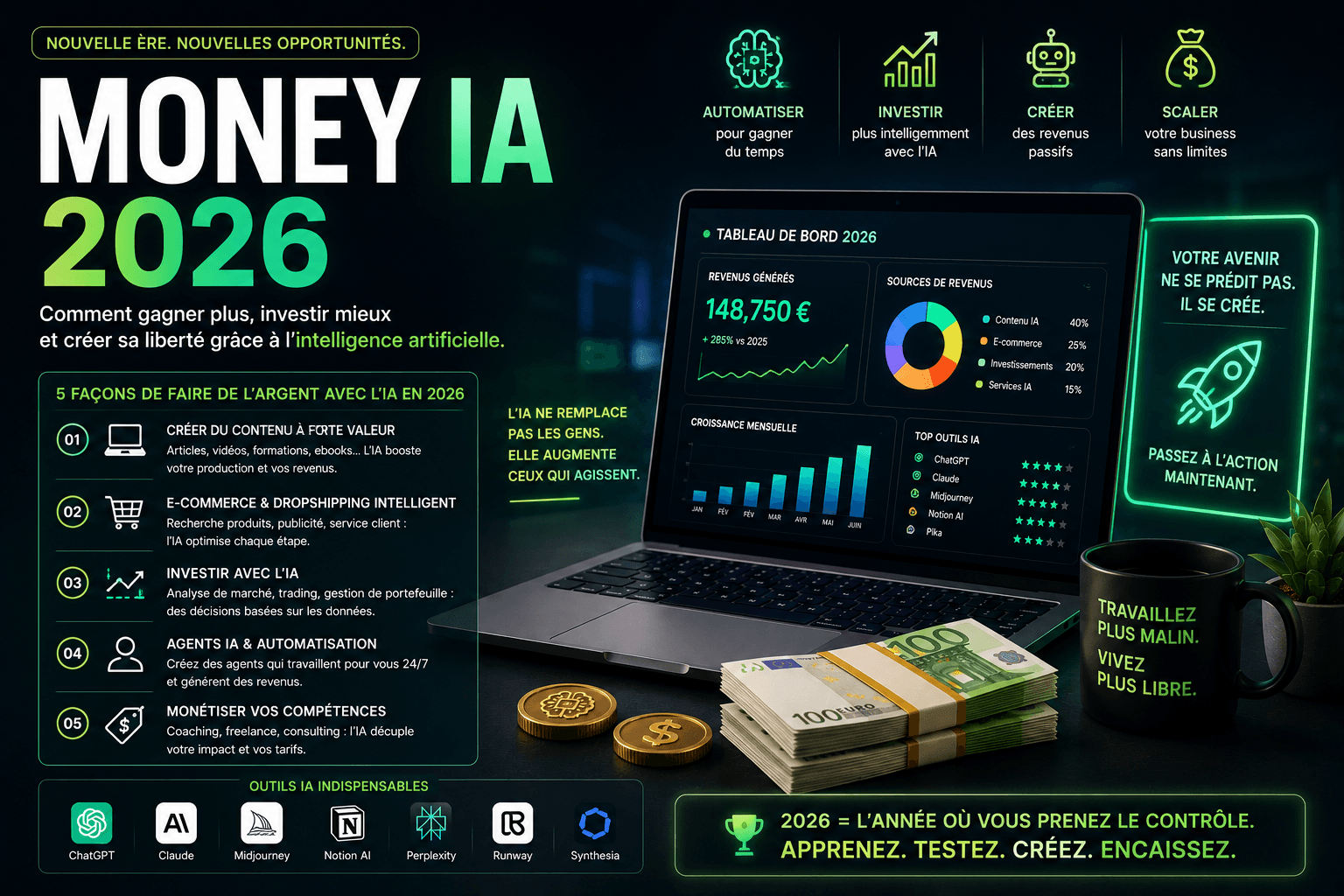
YouTube promises $10,000/month while you sleep. Reality is different — and far more interesting. Here are 7 concrete methods tested in 2026, with real numbers and zero marketing fluff.
!Article illustration: How to Make Money with AI in 2026: What Actually Works (No Hype)
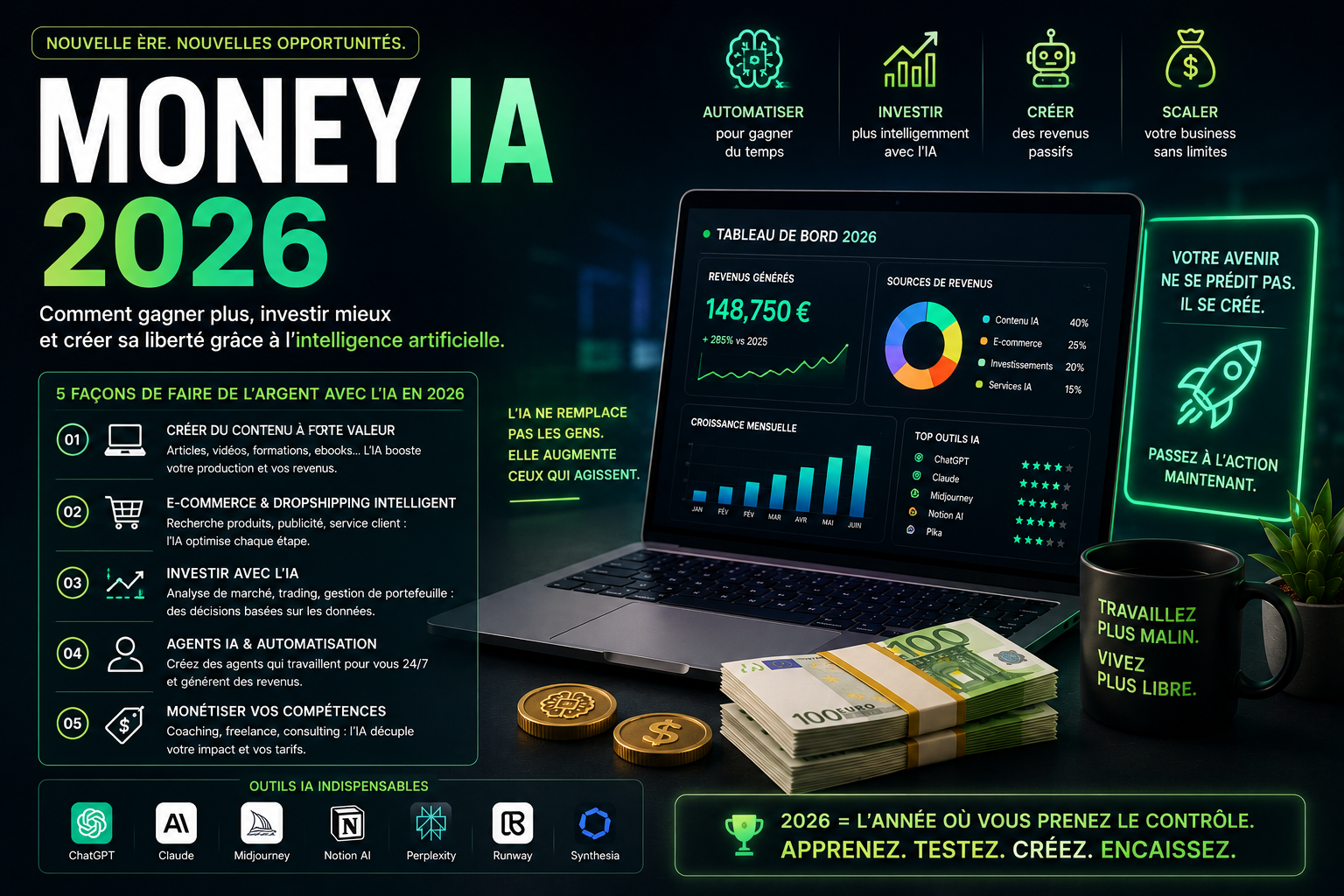
What nobody actually tells you
Search "make money with AI" on YouTube and you'll find thumbnails featuring five-figure revenue dashboards, promises of "no skills required," and magic formulas sold for $997. That's noise.
The real picture is both more grounded and more compelling: AI doesn't create money on its own. It accelerates what already exists. It removes friction. It lets you produce in an hour what once took a full day, or serve ten clients with the bandwidth you previously had for three. It's a lever — not a money printer.
This guide doesn't promise easy riches. What it does is show you where that lever creates genuine value in 2026, backed by verified data and concrete tools. The methods below work because they solve real problems for real clients — AI simply makes delivery faster and more scalable.
One important caveat before diving in: income from freelancing, affiliate programs, or digital products may be taxable depending on your country. Check your local regulations before you start earning significant amounts. In the US, freelance income above $600/year requires reporting. In the UK and EU, similar thresholds apply.
---
What the market actually looks like in 2026
The numbers are public, and they tell a clear story. According to ZipRecruiter (March 2026), the median annual pay for an AI freelance role in the US is $89,600, roughly $43/hour. Specialized AI automation profiles command $116,000 to $141,000 annually according to Glassdoor data from the same period.
A Medium study published in March 2026 identifies three distinct AI income levels:
- Level 1 — AI-enhanced services: +20 to 50% income boost on your existing work, very low barrier to entry, near-immediate results.
- Level 2 — AI implementation: $40,000 to $150,000 annual potential, moderate technical skills required.
- Level 3 — AI development: $150,000 to $400,000+ annually, deep expertise needed.
One consistent finding across all available 2026 analyses: specialists earn 2 to 3 times more than generalists. Choosing a precise niche is the single most profitable decision you can make before you launch anything.
---
Method 1 — AI-augmented writing and content
How it works
This is the most accessible entry point by a significant margin. A writer who integrates Claude or ChatGPT into their workflow can multiply output by 3 to 5 without sacrificing quality — as long as they understand that AI produces first drafts, not finished content. Your value remains in strategy, voice, fact-checking, and the human touch that separates a merely readable text from one that actually converts.
One documented case: a Chicago-based content agency with four employees implemented AI across their workflow in 2025. The outcome was a 300 to 500% production increase, with monthly retainers shifting from $150-300 per individual article to $3,000-8,000/month for comprehensive programs of 8 to 12 sourced, SEO-optimized articles. The AI didn't create the value — repositioning from one-off service to ongoing strategic program did. AI just made the economics work.
What you can realistically earn
On freelance platforms like Upwork, Toptal, and Fiverr, demand for writers who can produce high quality work quickly has surged. In 2026, market rates for an AI-augmented specialist freelancer run $50 to $150/hour depending on niche (tech, medical, and finance pay more). A freelancer working 15 hours per week on this model can target $2,500 to $5,000/month in revenue.
The best-paying niches in 2026: B2B SaaS and tech, finance and crypto, premium health and wellness, legal and compliance. Generalist niches pay less and face steeper competition.
Tools to get started
Claude for long-form, nuanced writing — still the market leader for text quality in 2026. Perplexity for sourced research. Surfer SEO for optimization. Notion AI for managing briefs and client deliverables.
Startup cost: Claude Pro ($20/month) + Perplexity Pro ($20/month) = $40/month. You break even on the first article delivered at a serious rate.
---
Method 2 — AI automation consulting for small businesses
Why this has the best effort-to-income ratio
Small and medium-sized businesses spend an average of 10 to 20 hours per week on repetitive tasks that AI can handle: data entry, report generation, email routing, CRM updates, lead qualification. They know it. They just don't know how to set it up.
That's where you come in. No coding required. Tools like n8n, Make, or Zapier let you build automation workflows visually, without writing a single line of code. Add Claude or GPT-5.4 as the AI brain inside those workflows, and you build systems worth several thousand dollars to your clients.
The most effective model in 2026 according to KDnuggets: consulting first. An initial paid session to audit the client's processes and identify automation opportunities ($500 to $1,500). Then implementation ($3,000 to $8,000 per project). Then a maintenance retainer ($500 to $2,000/month). One well-served client can represent $10,000 in revenue over the first year.
What you actually automate
The most requested and most profitable workflows to implement in 2026:
Incoming document processing: invoices, forms, contracts — automatic data extraction, validation, and integration into CRM or ERP. A workflow like this saves a mid-sized SMB 5 to 10 hours per week.
Lead qualification and routing: a prospect fills a form → AI analyzes their profile → classifies into a category → sends a personalized reply → creates a CRM task → notifies the right salesperson. Zero human touch required.
Automated reporting: weekly sales summaries, support ticket digests, or marketing performance reports — generated and sent automatically every Monday morning.
Email inbox triage: AI reads incoming emails, categorizes them, drafts template responses for common cases, and escalates only complex situations to a human.
Real market numbers
According to mid-2026 data, an automation freelancer can bill $75 to $150/hour for implementation, without a computer science degree. The global workflow automation market is projected to reach $78.7 billion by 2030. The window to establish yourself as an expert before competition intensifies is open right now.
Startup cost: n8n self-hosted (free) or Make Core ($9/month) + Claude API (usage-based). Very low initial investment.
---
Method 3 — Building a micro-SaaS with vibe coding
The quiet revolution of 2026
Across Reddit, LinkedIn, and builder communities, a recurring pattern has emerged: non-technical founders launch functional SaaS products in a week using tools like Lovable, Bolt.new, or Base44, gather early users, then introduce a paid tier at $19 or $29/month.
This is no longer niche. It's become a fully-fledged model generating real revenue. A well-targeted micro-SaaS — solving one specific problem for one specific audience — can reach $1,000 to $5,000 in Monthly Recurring Revenue within a few months, with very low maintenance costs.
How to build something that actually sells
The fundamental rule, often ignored: solve a problem you know from the inside. The best micro-SaaS products of 2026 came from founders who experienced the problem themselves and found no satisfying solution on the market.
The four-step process:
1. Identify the problem: scan Reddit threads, Facebook groups, LinkedIn comments where people complain about a repetitive task or missing tool. Sentences starting with "I wish there was something that..." are gold.
2. Validate before building: talk to 10 people who have the problem. Ask whether they'd pay $20/month for a solution. If 3 out of 10 say yes without hesitation, build it.
3. Build with vibe coding: Lovable for a full stack with authentication and Supabase database in a few hours. Base44 if you want maximum simplicity. Bolt.new if you have some technical background.
4. Launch, don't perfect: your V1 will be imperfect. Launch anyway. Feedback from early users is worth more than three weeks of solo refinement.
Underexplored niches in 2026
Automated report generation for real estate agencies. Raw material price tracking with custom alerts. Meeting summarization for consulting firms. Review and testimonial management for e-commerce brands. Competitive intelligence dashboards for SMBs.
Startup cost: Lovable Starter ($20/month). Hosting included via Supabase (free up to a certain volume). Potentially profitable from the third paying customer.
---
Method 4 — AI-generated digital products
The most genuinely passive model that exists
Selling digital products is one of the rare models where "passive income" isn't a lie — provided you invest the initial time to create something genuinely useful. AI has cut creation time by a factor of ten, making the model viable even for someone starting from scratch.
Digital products selling well in 2026 on Etsy, Gumroad, or through a personal website:
AI templates and prompt frameworks: curated prompt packs organized by use case, prompt systems for ChatGPT or Claude adapted to a specific industry ("100 prompts for business coaches"). On Gumroad, creators sell these packs for $15 to $79 and generate hundreds of passive sales.
Notion templates and productivity tools: project management systems, freelance trackers, content dashboards. The Notion template market remains active, with bestsellers at $25 to $49 generating recurring revenue through regular updates.
PDF guides and short video courses: the e-learning market is projected at $370 billion in 2026. Focused short guides (40 to 80 pages) on precise topics — "How to use n8n to automate your LinkedIn outreach" — sell for $20 to $49 and can be produced in a few days with AI assistance.
AI visuals for print-on-demand: illustrations, t-shirt designs, posters, personalized products sold on Redbubble, Merch by Amazon, or Teepublic. Production is near-unlimited once a Midjourney or Flux workflow is established.
The honest reality of this model
What doesn't work: creating 50 generic products and hoping they sell themselves. SEO and distribution take time.
What works: 3 to 5 quality products in a specific niche, plus even a small audience (newsletter, LinkedIn, TikTok) to promote them. A creator with 2,000 engaged subscribers in a relevant niche consistently outsells one with 50,000 generic followers.
Startup cost: Gumroad (free + 10% commission until $10k revenue, then lower). Midjourney for visuals ($10/month). Claude for writing ($20/month). Profitable from the first sale.
---
Method 5 — AI-augmented social media management
A demand that's exploding, supply still catching up
SMBs need a presence on LinkedIn, Instagram, and increasingly TikTok. They have neither the time nor the skills to do it properly. A freelancer who masters AI content creation tools can manage 5 to 8 clients simultaneously where, without AI, they could handle 2 or 3.
The productivity gap is real: with Claude for copywriting, Midjourney or FLUX for visuals, and Buffer or Hootsuite for scheduling, a full week of content (5 posts + stories) can be produced in 2 to 3 hours instead of a full day.
How to structure the service
The pricing structure that works in 2026: all-inclusive monthly retainers rather than hourly billing. A basic LinkedIn client (3 posts/week + engagement): $500 to $800/month. An Instagram client with visuals and stories: $600 to $1,200/month. A client requiring short-form video content (Reels, TikTok): $1,000 to $2,500/month.
With 5 clients averaging $800/month: $4,000 in monthly revenue for 20 to 25 hours of actual work. With AI handling the repetitive parts, margins are strong.
Specialization as competitive advantage
Again: niche pays more. A social media manager specializing in law firms charges 2 to 3 times more than a generalist. Same applies to luxury real estate, medical practices, and B2B SaaS startups. Specialization lets you build reusable templates and be perceived as an expert rather than a vendor.
Startup cost: Claude ($20/month) + scheduling tool like Buffer ($15/month) + Canva Pro for visuals ($15/month) = roughly $50/month. Profitable from the first client.
---
Method 6 — AI tool affiliate marketing
The most underrated model in the space
AI affiliate marketing is, in 2026, one of the most profitable affiliate niches that exists. The reason is straightforward: tools pay well (commissions of 20 to 40%), subscriptions are recurring (you earn as long as the customer stays subscribed), and the market is still young with many people searching for honest reviews before buying.
Some publicly available commission structures in 2026:
Jasper AI: 30% recurring. With 10 clients on a Creator plan ($49/month), that's $147/month in passive income — from a single tool.
Notion: 50% the first month, 20% ongoing.
ElevenLabs: active partner program with conversion-based commissions.
n8n: partner program for agencies.
Lovable: active affiliate program with commissions on subscriptions.
Building an audience that actually converts
The classic trap: trying to promote everything to everyone. It doesn't work. What works: a niche audience (newsletter, blog, LinkedIn account) that trusts you because you share genuine analysis, honest comparisons, and no hidden promotions.
A publication that compares tools with real tests and transparent methodology is exactly the kind of content that converts in affiliate marketing. Readers trust the verdict because they see the process behind it.
Transparency isn't optional: in most countries, affiliate links must be explicitly disclosed. It's also good practice for maintaining long-term audience trust — the most valuable asset in this model.
Startup cost: zero if you already have an audience. Otherwise, invest in SEO content creation (keyword analysis tools at $30 to $50/month) to generate organic traffic over time.
---
Method 7 — AI consulting and training for businesses
The highest-paying method, for the right profiles
Companies are spending heavily to understand and deploy AI, but they're struggling to find people who can translate it concretely to their specific context. An AI consultant who combines tool knowledge, sector experience, and the ability to simplify complexity can charge $500 to $2,000 per day for consulting missions or training sessions.
The global AI agents market is projected to reach $182.97 billion by 2033 (49.6% annual growth). Organizations that were slow to adopt AI are now racing to catch up, creating massive demand for people who can guide them through the transition.
How to position yourself without 20 years of experience
The good news: you don't need to be an AI researcher to be a business AI consultant. What clients actually need is someone who understands which tools exist, how to evaluate them in context, and how to support the human change that adoption requires.
The model that works: combine your existing professional expertise with AI tool mastery. A former accountant who masters AI automation of financial processes is far more credible — and far better paid — than a generic AI generalist who doesn't understand accounting. A former HR director who trains companies on AI in recruitment has a natural competitive edge that takes years to build from scratch.
The formats that sell
In-company training (half-day to two days): $500 to $2,000 per session depending on format and client. Content: LLM fundamentals, daily use of ChatGPT/Claude, professional use cases, limitations and risks.
AI maturity audit: organizational diagnosis, mapping of automatable processes, deployment roadmap. $1,500 to $5,000 depending on company size.
Long-term accompaniment: monthly retainer to follow implementation, answer questions, train new hires. $1,500 to $5,000/month depending on scope.
Startup cost: ongoing learning on available tools (free or near-free with freemium plans), building an optimized LinkedIn profile, and one initial case study — even at reduced rates to build credibility.
---
The honest picture on timelines and numbers
A straight synthesis of what to expect depending on where you're starting.
If you already have professional expertise (writer, marketer, consultant, developer...): AI can increase your income by 20 to 50% within the first few weeks. No need to learn a new trade — just new tools.
If you're starting from scratch: expect 1 to 3 months to master the tools, land your first clients, and deliver results that justify real fees. A first month at $500 is realistic. $1,000 to $2,000 is achievable by month three with consistency.
Profiles that fail: those who try 10 methods simultaneously and master none. Those who expect AI to do the work for them. Those who don't invest in the quality of their deliverables.
Profiles that succeed: those who choose one method, apply it for 30 to 60 days before trying another, and bring genuine value to clients rather than chasing raw output volume.
---
Where to start tomorrow morning
No generic conclusion. Just one direct question: what is your actual starting point today?
You already have clients → Integrate Claude into your workflow tomorrow. Measure the time saved. Increase your volume or your rates based on what it frees up.
You have expertise but no clients yet → Choose a niche (writing, automation, social media), create 2 or 3 work samples on fictitious or reduced-rate projects, and start prospecting on Upwork or LinkedIn.
You're genuinely starting from zero → Begin with digital products or affiliate marketing. Lowest barrier to entry, near-zero financial risk, and you learn the tools while building something real.
AI amplifies what you already bring to the table. If you're not bringing anything, it amplifies nothing. But if you have genuine value to offer — even modest, even beginner-level — AI can multiply that value meaningfully.
The time to start is now. Not after you finish this guide. Now.
FAQ
Do I need technical skills to make money with AI?
No, for most methods in this guide. AI-augmented writing, social media management, digital products, and even basic automation (with Make or Zapier) are all accessible without coding skills. Advanced automation and micro-SaaS development require a bit more, but tools like Lovable let you build functional applications without writing a single line of code.
How much can you realistically earn with AI?
A serious beginner can target $500 to $1,500/month in additional income within 3 months. An experienced freelancer who integrates AI can increase their income by 20 to 50%. A specialist in automation or AI consulting can reach $5,000 to $15,000/month — but that requires genuine sector expertise and a clear positioning.
Which method is fastest to start?
AI-augmented writing. You can have your first client within days if you have basic writing skills. Second fastest: social media management for local SMBs (restaurants, boutiques, small professional practices).
Will AI replace freelancers?
It replaces repetitive tasks, not people who bring expertise, client relationships, and contextual judgment. Freelancers who use AI intelligently are replacing those who don't — not the other way around. It's a race, and it's still very much runnable for those who get started now.
Is this income taxable?
Yes. Most countries require you to report and pay tax on freelance, affiliate, or digital product income above certain thresholds. In the US, freelance income above $600/year must be reported. In the UK, the trading allowance is £1,000/year before you need to register. Check your local regulations and consider speaking with an accountant before your income becomes significant.
6 articles to read next
- How to Write AI Prompts That Actually Work in 2026 — The Complete Guide — Productivity, 35
- Why AI Makes Things Up — And How to Stop Getting Fooled in 2026 — Productivity, 29
- 12 AI Prompt Mistakes Everyone Makes — and How to Fix Them — Productivity, 28
- AI and SEO in 2026: The Complete Playbook to Rank Without Getting Penalized — Productivity, 27
- Notion AI in 2026: genuinely useful or just hype? — Productivity, 2
- GitHub Copilot vs Codeium: which really boosts your code? — Code, 2